
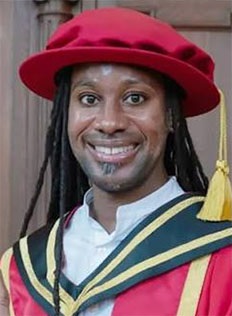
The late Jason Arday
HABARI DAILY I Kampala, Uganda I When Cambridge University reneged on it’s decision to stand by him amidst daunting allegations, the late, young professor became too weak to stand on his own.
Jason Arday, who made history as Cambridge University’s youngest Black professor at the age of 37, has died at 41 after weeks of intense public scrutiny over allegations of plagiarism and questions about some of the extraordinary achievements that had shaped his public profile.
Arday, a British sociologist and professor of sociology of education, was found unresponsive inside a home in Battersea, south London, on Friday afternoon. The Metropolitan Police confirmed that a 41-year-old man had been pronounced dead but did not name him, saying the death was unexpected but was not believed to be suspicious.
His death came only days after he resigned from Cambridge and as his memoir, Great and Unfortunate Things, was being released by Simon & Schuster.
In a statement issued through his publisher, Arday’s family said they were “in shock” at losing an “amazing father, partner, brother, uncle and son.”
They blamed what they described as a sustained campaign of misinformation and abuse for placing an unbearable burden on the academic.
Toxic campaign was too much
“The campaign of misinformation was too much for Jason,” the family said, describing him as a gentle man who always sought to see the best in people.
The family further said that for three years Arday had been subjected to sustained abuse by people determined to undermine him.
The controversy intensified in July after questions were publicly raised about his academic credentials. On July 24, The Times published an analysis of Arday’s 2015 doctoral thesis, identifying passages it said were identical or nearly identical to material in an earlier paper by another researcher.
The allegations did not stop at his academic work. British media also questioned claims that Arday had raised £5.5 million for charity through extraordinary endurance feats, including running 30 marathons in 35 days and covering 600 miles in six days.
Arday denied plagiarism, although he acknowledged that mistakes had been made during his doctoral work.
His resignation statement revealed the personal toll of the controversy.
“The relentless accusations, speculation and public commentary have taken a profound toll on me and on those I love,” he said.
Yet he insisted that his decision to leave Cambridge should not be interpreted as accepting the allegations or narratives surrounding him.
University withdrew support
The tragedy became more complicated because Cambridge had initially stood firmly behind its professor. The university said the plagiarism allegations had previously been investigated by Liverpool John Moores University, which awarded Arday his doctorate.
But after dozens of Cambridge academics signed a letter demanding an independent inquiry into his appointment, the university changed course.
Cambridge announced an investigation after receiving what it called “new information” concerning Arday’s qualifications and honorary appointments. Vice-Chancellor Deborah Prentice also announced a review of the university’s hiring procedures.
Only days before his death, Prentice stressed that the case should not be used to question the legitimacy of other Black academics at Cambridge, saying staff of colour were highly valued for their scholarship, achievements and contributions.
Arday’s rise to the top of British academia had been remarkable. He had spoken openly about overcoming dyslexia, developmental delays and autism, saying he remained non-verbal until he was 11 and illiterate until his late teens.
His personal journey made his appointment at Cambridge particularly inspirational.
Destined for greatness
In his memoir, he recalled being told as a child that his long fingers were a sign that he was destined for greatness. Years later, during a relief mission in Brazil, another aid worker predicted that he would lead an extraordinary life—but warned that he was also destined for “very sad and difficult things.”
Those words now carry a haunting significance.
More than two dozen academics and politicians had defended Arday, describing the allegations against him as a smear campaign that could discourage Black people from seeking positions of influence.
But the pressure continued until he walked away from the professorship he had once described as an extraordinary achievement.
Cambridge has said its investigation into the allegations will continue. For Arday’s family, however, the academic debate has been overtaken by a far more painful reality: the loss of a young man whose journey from profound childhood challenges to one of Britain’s most prestigious universities had once appeared to be a story of triumph.
Now, it has ended in a tragedy that has left questions about academic accountability, institutional responsibility, media scrutiny and the human cost of public controversy hanging over his legacy.







About the Author