

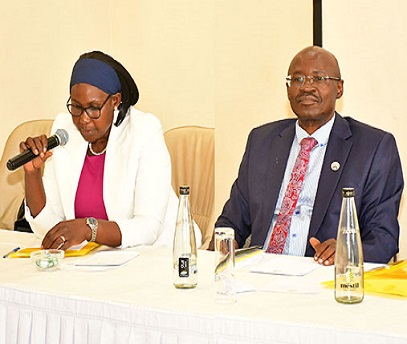
John Kauta, the Commissioner for Planning and Health Information Systems at the Ministry of Health, said the government had deliberately designed the programme to address geographical gaps in access to hospital services, in a major expansion of healthcare infrastructure aimed at bringing services closer to underserved communities.
“The planned facilities will be established through the World Bank-funded Uganda Health Services Transformation Project, under which about 100 existing Health Centre IVs are expected to be upgraded into community hospitals,” he said on Thursday, during the ongoing Financial Year 2027/28 national grant negotiations between central and local governments.
Organised by the Local Government Finance Commission (LGFC) at Mestill Hotel, the negotiations are being held between 17th – 25th August, and have brought together officials from ministries, departments and Agencies (MDA) as well as local governments.
Health center upgrades
“Some health centre IV’s will be upgraded to community hospitals. And we shall start with districts that do not have any general hospital,” Kauta said, adding that the programme will cover about 100 districts, with selection based primarily on whether a district already has a general hospital.
“About 60 districts currently have general hospitals, meaning those without such facilities will receive priority under the new programme,” he said, adding that the expansion is expected to significantly alter Uganda’s health infrastructure landscape, particularly in districts where patients currently have to travel long distances to access hospital-level care.
Among the districts identified as lacking adequate hospital infrastructure are Namisindwa, Manafwa, Bulambuli, Sironko and Budaka in eastern Uganda, as well as Kween in the Sebei sub-region.
Kauta said implementation is expected to begin towards the end of this year, with construction activities likely to commence from December onwards.
“The community hospitals are part of a broader government strategy to strengthen lower-level health facilities and improve referral services,” he noted, adding that alongside the 100 community hospitals, government also plans to upgrade some Health Centre IIs to Health Centre IIIs under the Uganda Intergovernmental Fiscal Transfers (UgIFT) programme.
New health Center III’s
In addition, new Health Centre IIIs will be established in sub-counties that currently do not have such facilities, further expanding access to primary healthcare.
“The government believes that improving infrastructure must go hand in hand with increasing the number of health workers available to serve the growing population.”
Kauta said the National Development Plan IV has set a target of increasing staffing levels in the health sector from the current 34 percent to 55 percent by 2029/30.
He said priority recruitment will focus on midwives, nurses, doctors, pharmacists, nutritionists and health educators.
“These have all been listed out in the budget financing guidelines on which positions should be recruited in our health facilities,” Kauta said, adding that the guidelines would be provided to local governments to guide recruitment.
Growth in service delivery
The staffing component is particularly important because Uganda continues to face a significant shortage of health professionals despite improvements in infrastructure and training.
Kauta said Uganda’s health sector had registered improvements in service delivery, health infrastructure and the number of trained health workers.
He noted that more than 80 percent of Ugandans can now access a health facility, compared to a situation in the past when accessing healthcare services was considerably more difficult.
However, he acknowledged that the country still faces a major challenge in the ratio of health workers to patients.
“Uganda currently has approximately one doctor for every 25,000 people, compared with the World Health Organization recommendation of one doctor for every 1,000 people. This creates a big gap,” Kauta said.
He attributed part of the challenge to inadequate funding for recruitment, noting that many trained doctors, nurses, midwives and other health professionals remain outside the formal health service because government has not been able to absorb them.
Kauta said filling even half of the existing staffing structures would make a significant difference in service delivery and reduce the shortage of health workers.
He argued that increased government revenues and economic growth would be essential to providing the resources needed to recruit and retain health workers.
Emergency Medical Services
Dr John Baptist Waniaye, the Commissioner for Emergency Medical Services at the Ministry of Health, is expected to provide further details on the financing and implementation of the Uganda Health Services Transformation Project.
The planned community hospitals are also expected to strengthen Uganda’s emergency medical care system by improving the availability of hospital-level services closer to communities.
With construction expected to begin from December, the programme could become one of the government’s most significant investments in decentralising healthcare services, particularly for districts that have historically depended on neighbouring areas for general hospital services.
The initiative is therefore expected to complement existing efforts under UgIFT and other health sector programmes by creating a more comprehensive network of health facilities, from Health Centre IIIs and IVs to community and general hospitals.
“For underserved districts, the proposed 100 community hospitals could reduce the distance patients travel for specialised and emergency treatment while easing pressure on existing general hospitals.”
Local Government Finance Commission’s counsel
Adam Babaale, the secretary to the LGFC said that the success of the programme will ultimately depend not only on constructing the facilities but also on equipping them, staffing them adequately and ensuring sustainable financing for medicines, operations and maintenance.







“With government targeting a rise in health-sector staffing to 55 percent by 2029/30, the infrastructure expansion and recruitment drive will have to advance together if the country is to translate the new facilities into better and more accessible healthcare for Ugandans,” he said.:
About the Author