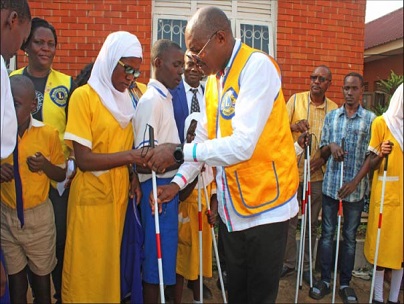
Byarugaba hands over a white cane to a pupil during an event where UNAB received 100 white canes from the Lions Club of Kampala East on Friday
HABARI DAILY I Kampala, Uganda I Although they are impaired, they are not disabled and can lead normal lives, provided they have the necessary tools to navigate their surroundings independently, the Uganda National Association of the Blind (UNAB) has said, highlighting the urgent need for white canes for more than two million visually impaired Ugandans.
Dennis Tumwebaze, the UNAB executive director, said the white cane, which may appear insignificant to a sighted person, is a lifeline for someone who is blind because it enables them to move safely and independently.
The cane helps users detect physical obstacles, stairs and changes in surfaces as they move through different environments. It also serves as a recognised symbol of visual impairment, alerting members of the public to the presence of a person with sight loss.
“We have managed to develop a register for visually impaired persons across the country,” Tumwebaze said.
He explained that, working through district structures, UNAB has so far registered more than three million people with visual impairments across 110 districts. The register includes people with low vision as well as those who are blind.
However, Tumwebaze said more than two million of those registered face mobility challenges because they cannot afford to purchase white canes.
For many of them, the lack of a proper cane means resorting to improvised alternatives. Some use ordinary wooden sticks, which they paint red and white in an attempt to make them resemble standard white canes.
The cost of a white cane ranges between Sh75,000 and Sh1.5 million, depending on the market and type, putting the mobility aid beyond the reach of many visually impaired people.
Tumwebaze made the remarks during an event at UNAB offices on Kireka-Namugongo Road in Wakiso district, where the association received 100 white canes donated by the Lions Club of Kampala East.
Some of the donated canes were distributed to 25 learners from Sir Apollo Kaggwa Inclusive School, Salaama School for the Blind and Bukoto Islamic School.
Tumwebaze thanked the Lions Club for the donation, saying the canes would enable visually impaired learners, young people and the elderly to move around their environments more confidently and live independent lives.
He said improved mobility would also allow visually impaired people to participate in socio-economic activities, including farming and business.
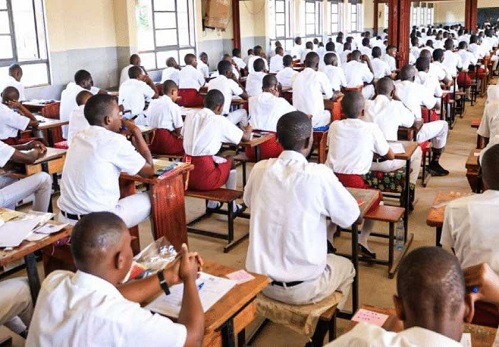
Dorothy Ssebadduka, headteacher of Salaama School for the Blind in Mukono district, said the impact of the canes extends into the classroom and school environment.
With the canes, she said, learners can move more easily and enjoy school because they are able to identify their classrooms, dormitories, kitchen and other areas within the school.
Amon Mugume, who represented UNAB board chairperson Richard Anguyo, emphasised that the white cane is not merely an aid but also has legal significance.
“The white cane is a recognised tool for mobility in the road and traffic laws,” Mugume said.
He explained that when a person is carrying a white cane, motorists and pedestrians are required to respect it. The cane also signals to other road users that its holder is blind.
Mugume thanked the Lions Club of Kampala East for supporting visually impaired people and urged the public to join UNAB in commemorating International White Cane Day on October 15 in Koboko district.
John Kikanu Byarugaba, Lions Club International District Governor 411B, said the organisation has a long history of supporting people with visual impairments.
He noted that the Lions began focusing on vision in 1925 after Helen Keller challenged members to become “Knights of the Blind”.
“As Lions, we believe that service should make a practical difference in the lives of the people who are supposed to be impacted,” Byarugaba said.
He urged the Government and Ugandans to support visually impaired students to complete their education and enable young people to engage in economic activities.
For UNAB, the 100 donated canes provide immediate relief to a small number of beneficiaries, but the much larger challenge remains: ensuring that the more than two million visually impaired Ugandans struggling with mobility can access the basic tool they need to move safely, study, work and participate independently in society.