
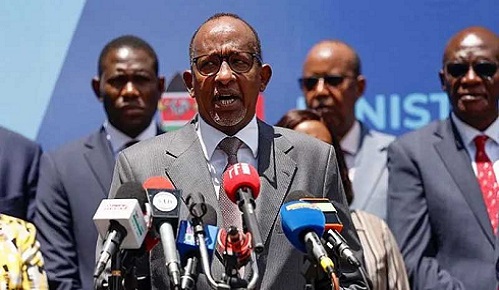
Aden Duale, Kemya’s Health Minister addressing the press early today
HABARI DAILY I Kampala, Uganda I Kenya has confirmed its first-ever case of Ebola after a Kenyan man who had lived in the Democratic Republic of Congo (DRC) for seven years died in Nairobi after testing positive for the Ebola Bundibugyo virus.
Health Cabinet Secretary Aden Duale confirmed the case on Tuesday, October 6, 2026, saying the patient had travelled from the DRC through Uganda before arriving in Nairobi, where he was admitted to an isolation facility.
The identity of the man has not been publicly disclosed by Kenyan health authorities.
Duale said the patient had fallen ill about a month earlier and had received treatment at several hospitals in the DRC before beginning his journey back to Kenya.
He travelled by road from the DRC to Kampala and subsequently boarded Jambojet flight 8523 to Nairobi on Saturday, October 3.
After arriving at the Jomo Kenyatta International Airport, he underwent routine public health screening before being taken to hospital by a relative.
He was initially admitted to Nairobi Hospital before being transferred to an isolation facility established during the Covid-19 pandemic.
According to Duale, doctors suspected a viral haemorrhagic fever because of the man’s symptoms and travel history.
He developed fever, chills, intense fatigue and weakness, painful swallowing, muscle pain and bleeding under the skin.
Samples collected from the patient subsequently tested positive for Ebola Bundibugyo virus.
The patient died at 11:30pm on Monday, October 5, shortly after his admission and isolation.
His burial was scheduled for Tuesday under public health safety protocols designed to prevent possible transmission during handling of the body.
Duale said authorities had already identified at least 28 contacts, including relatives and healthcare workers who may have been exposed to the patient.
Health officials are also tracing 23 passengers and four crew members who travelled on the same Jambojet flight from Kampala to Nairobi.
The tracing operation is intended to establish whether anyone may have been exposed during the journey and to monitor identified contacts for symptoms.
Duale urged Kenyans not to panic, saying the country’s health systems were prepared to respond to the case and prevent further transmission.
He also directed health workers to maintain heightened vigilance and observe strict infection prevention and control measures regardless of the illness being treated.
Ebola is highly infectious but does not spread through ordinary casual contact. Transmission occurs primarily through direct contact with the blood or other bodily fluids of an infected person, particularly once the patient develops symptoms.
The confirmation of the case nevertheless presents a significant public health challenge because the patient travelled through Kampala and was on a commercial flight before his diagnosis.
Uganda itself experienced an Ebola outbreak earlier this year after the disease spread from the DRC. Two people died before the World Health Organization declared Uganda free of Ebola in August.
Since then, known cases have remained concentrated in the DRC. The Kenyan case is linked to an Ebola outbreak in the DRC that health authorities say has become the country’s largest recorded outbreak.
The World Health Organization has recorded 8,463 cases and 4,082 deaths in the current outbreak, making it the second most deadly known Ebola outbreak globally.
Medical charity Médecins Sans Frontières (MSF), however, has warned that the actual toll could be higher because insecurity and weaknesses in surveillance and testing make it difficult to identify every case.
The outbreak has also intensified in North Kivu province, which borders Ituri, where the virus initially emerged.
MSF said the spread had intensified dramatically since early September, with North Kivu accounting for nearly 40 percent of newly confirmed cases nationwide.
The Kenyan patient tested positive for the Bundibugyo species of Ebola, the strain responsible for the current outbreak in the DRC.
The strain is relatively rare compared with other Ebola species, and there is currently no approved vaccine or specific treatment for Bundibugyo Ebola.
However, several vaccines are under development, with human trials for one candidate launched in July.
The outbreak has been complicated by decades of conflict in eastern DRC, where armed groups, political instability and competition over natural resources have disrupted communities and weakened healthcare infrastructure.
The conflict has displaced millions of people and made disease surveillance, treatment and contact tracing considerably more difficult.