
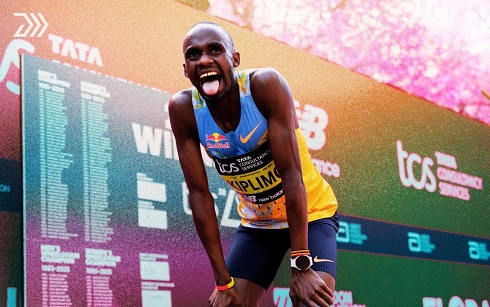
Jacob Kiplimo
HABARI DAILY I Kampala, Uganda I Uganda’s Jacob Kiplimo will face a defining test at the Chicago Marathon on October 11, 2026, with the prospect of rewriting marathon history competing against the more immediate challenge of defending his title.
While breaking the world record is attracting attention, weather conditions, pacing and the strength of the leading pack could determine how far the Ugandan star pushes the clock.
Two major targets dominate the conversation ahead of the race: the world record of 1:59:30, attributed to Kenyan runner Sabastian Sawe following his London Marathon performance in April 2026, and the Chicago course record of 2:00:35, established by the late Kelvin Kiptum in 2023.
Kiplimo’s personal best of 2:00:28 puts both marks within the realm of discussion, although the world record would require a substantially greater effort.
World record remains a difficult target
Sawe’s 1:59:30, set in London on April 26, is the benchmark Kiplimo would need to beat to become the new marathon world record holder. The Kenyan became the first man to complete an official marathon in under two hours, taking 65 seconds off Kiptum’s previous record of 2:00:35.
Kiplimo’s London performance in April, where he finished third in 2:00:28, demonstrated that he can compete at the very highest level. However, breaking Sawe’s record would require him to cut 58 seconds from his personal best over 42.195 kilometres.
Estimates cited in the record debate put Kiplimo’s chances of breaking the world record at around 10 to 20 per cent. Higher-than-ideal temperatures expected in Chicago could further complicate the challenge, with estimates suggesting that unfavourable conditions could cost elite runners between 25 and 65 seconds.
The world record therefore remains an ambitious target rather than an expectation. Even a small deterioration in conditions, particularly during the second half of the race, could make the required pace difficult to sustain.
Kiptum’s course record within reach
The Chicago course record of 2:00:35 presents a more attainable target. Kiplimo’s personal best is already seven seconds faster than that mark, although it was recorded on London’s course rather than in Chicago.
The Ugandan won the 2025 Chicago Marathon in 2:02:23, finishing more than a minute ahead of Kenya’s Amos Kipruto. His victory was the second-fastest performance in the event’s history at the time.
Kiptum’s 2023 performance established a formidable standard on Chicago’s flat, fast course. Beating it would give Kiplimo another historic achievement, even if he fell short of Sawe’s global mark.
Pacing and competition
Kiplimo’s record ambitions will also depend on how the race unfolds. Maintaining world-record pace over the full distance requires carefully controlled early kilometres, efficient energy use and the ability to sustain speed when fatigue sets in.
Kenya’s Amos Kipruto, who finished second behind Kiplimo in Chicago last year, is among the leading challengers. He recorded a personal best of 2:01:39 in London in 2026, giving him the credentials to provide competition near the front.
Whether Kiplimo can find a runner capable of matching his pace deep into the race could determine if he makes a serious attempt at the record or prioritises winning.
Victory remains Kiplimo’s priority
Despite the speculation, Kiplimo has emphasised the importance of defending his title. A second consecutive Chicago victory would be a landmark achievement, as no Ugandan has previously won the same World Marathon Major in successive editions.
The race on October 11 will therefore test more than his speed. It will measure his ability to balance ambition with tactical judgement over a demanding distance.
For Uganda, a successful title defence would strengthen Kiplimo’s standing among the world’s leading distance runners. A course record would elevate the achievement further, while a world record would place him at the centre of marathon history.
The clock will attract attention, but Kiplimo’s immediate task is clear: win in Chicago. The records will depend on whether the conditions, pacing and competition allow him to turn that ambition into an extraordinary performance.