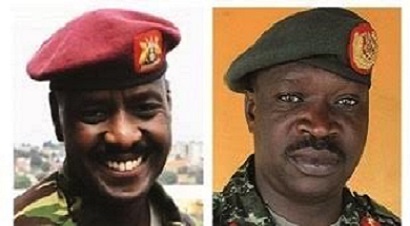
Gen. Muhoozi Kainerugaba (L) and former Deputy CDF Lieutenant General Peter Elwelu
HABARI DAILY I Kampala, Uganda I The military shakeup within the Uganda People’s Defence Forces (UPDF) has taken a dramatic turn after Chief of Defence Forces Gen. Muhoozi Kainerugaba announced that former Deputy CDF Lieutenant General Peter Elwelu had been stripped of his military ranks and demoted to Private, raising questions about military discipline, command authority and the future of the country’s security leadership.
Today, October 27, 2026, Kainerugaba publicly declared Elwelu a “traitor” and announced that he had been reduced from the rank of lieutenant general to the lowest level in the military hierarchy.
The announcement marks a significant development involving a former senior commander who once wielded considerable influence within the UPDF. Its implications extend beyond Elwelu’s personal standing, potentially affecting the military’s internal relationships, disciplinary procedures and the perception of stability within the command structure.
Consolidation of Military Authority
The demotion sends a strong message to serving and retired military officers about the authority of the current command. By publicly targeting a former deputy CDF, Kainerugaba has demonstrated his willingness to take action against a figure who previously occupied one of the army’s most senior positions.
The move could reinforce the expectation that officers remain accountable to the military leadership regardless of their past service or rank. However, it also raises questions about how disagreements within the armed forces are resolved and whether established disciplinary procedures are followed consistently.
The decision is particularly consequential because Elwelu previously served as commander of the land forces before becoming deputy CDF in June 2021. His subsequent removal from senior leadership and the latest announcement underline the extent of the change in his military standing.
The public declaration alone, however, does not establish the precise legal process through which the demotion was effected. Clarification of the formal decision, the grounds for it and any available review mechanism would help determine its institutional implications.
Arrests Widen the Scope of the Shake-up
The action against Elwelu has coincided with the reported arrest of more than 20 former soldiers linked to him.
Kainerugaba said the individuals were cooperating with military investigators, although detailed information about the allegations against them and the status of individual investigations had not been publicly provided in the announcement.
The arrests could widen scrutiny beyond the former deputy CDF and bring additional attention to relationships within his former military network. They may also affect morale among personnel who served alongside him, particularly if further disciplinary proceedings follow.
Nevertheless, association with Elwelu does not establish criminal wrongdoing. The credibility of the investigations will depend on the evidence gathered, the charges brought where appropriate and the procedures used to determine individual responsibility.
Historical Loyalty and Political Implications
Elwelu’s demotion also raises questions about the changing significance of historical loyalty within the military establishment.
The former general commanded the UPDF’s 2016 operation against the Rwenzururu royal palace in Kasese, which resulted in the deaths of scores of people. He later faced US sanctions linked to alleged human rights abuses arising from the operation.
His record makes the latest development particularly consequential. It illustrates how an officer’s previous position and service do not necessarily protect them from subsequent disciplinary action or a breakdown in relations with the military leadership.
Some observers may interpret the move within the wider context of Uganda’s eventual political succession. However, there is no publicly established evidence that the demotion was specifically intended to eliminate a potential rival ahead of a political transition.
The extent to which the action reflects a wider reorganisation of military relationships will become clearer as further details emerge.
Legal Process and Institutional Accountability
Perhaps the most significant question concerns the legal basis for reducing a former lieutenant general to Private.
Section 60 of Uganda’s UPDF Act states that an officer or militant cannot be demoted below their substantive rank except through a sentence of a competent military court or, in the case of a militant, through reversion or re-mustering. Section 219 also sets out provisions governing reduction in rank as a punishment.
These provisions make clarification of Elwelu’s military status and the procedure followed essential to understanding the announcement. The public declaration does not establish whether a military court issued a sentence or whether another applicable legal mechanism was invoked.
The use of social media to announce such a consequential decision also raises questions about institutional communication. While public statements can quickly convey the command’s position, formal documentation is important for distinguishing an announcement from an enforceable disciplinary decision.
For the UPDF, the handling of the case could influence public confidence in the consistency of military discipline and the independence of established procedures.
What Happens Next?
The demotion, together with the reported arrests of more than 20 former soldiers associated with Elwelu, marks a significant moment for the military leadership.
The next steps will depend on clarification of Elwelu’s status, the legal process underpinning the demotion and the findings of investigations involving the detained former soldiers.
If the allegations lead to formal proceedings, the evidence and outcomes will be central to determining individual responsibility. If the decision is challenged, the applicable review procedures could also become important.
Ultimately, the episode tests not only the authority of the CDF but also the UPDF’s ability to demonstrate that disciplinary power is exercised within established legal and institutional frameworks.







About the Author