
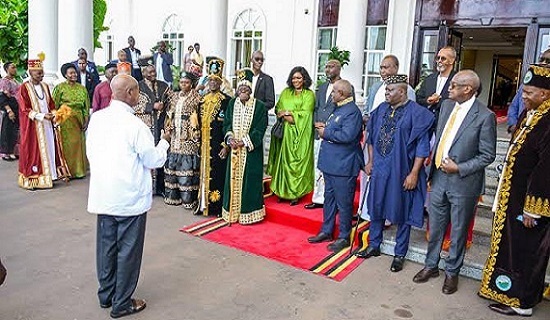
A cross section of traditional leaders who attended the meeting
HABARI DAILY I Kampala, Uganda I The absence of Buganda’s Kabaka Ronald Muwenda Mutebi II and Katikkiro Charles Peter Mayiga from President Yoweri Museveni’s two-day cultural leaders conference at State House Entebbe has triggered widespread debate, with questions being raised about whether Mengo deliberately snubbed the President’s invitation.
However, information emerging from unofficial channels suggests that the absence of the kingdom’s two top leaders was largely occasioned by scheduling conflicts, official assignments and the Kabaka’s need for rest, rather than a deliberate political boycott of the meeting.
While the absence of Buganda’s top leadership attracted considerable attention, particularly given the kingdom’s historical and political significance, sources indicate that there were practical reasons behind their failure to attend the gathering, which opened on Wednesday.
Kabaka Mutebi, who last weekend attended the Masaza Cup final at Muteesa II Stadium, Wankulukuku, was reportedly resting following the high-profile sporting event.
The monarch’s health and recovery have continued to attract public and media interest, making his movements and public appearances a subject of considerable attention.
His appearance at the Masaza Cup final had been particularly significant to his subjects, who turned up in large numbers to witness the climax of the annual Buganda football competition.
However, following the event, the Kabaka reportedly needed time to rest, which coincided with the President’s meeting with cultural leaders at State House.
Although his absence generated speculation, there was no official communication from the Buganda Kingdom suggesting that the monarch had deliberately declined the invitation as a political statement against Museveni’s call for traditional leaders to remain above partisan politics.
The situation was compounded by the absence of Katikkiro Mayiga, who was reportedly away on official kingdom business in the Ssese Islands.
Mayiga, who heads the Buganda Kingdom’s executive administration, plays a central role in coordinating the kingdom’s programmes, representing the Kabaka and managing relations with other institutions, including the central government.
His absence meant that the kingdom could not easily send its usual senior leadership to represent Mengo at the meeting.
The two deputies of the Katikkiro were also reportedly engaged in previously scheduled kingdom assignments, leaving the institution without an immediately available senior representative to attend the conference.
This combination of circumstances appears to have contributed to Buganda’s conspicuous absence from an event that brought together several traditional rulers and representatives from across the country.
Nevertheless, the absence of the Kabaka and Katikkiro quickly became a subject of political and cultural discussion on social media, with some commentators interpreting it as a reflection of Buganda’s historical relationship with the central government.
Fredrick Tumusiime argued that Buganda’s failure to send its monarch reflected the kingdom’s historical independence and unique position in Uganda’s political and cultural landscape.
“Notably, the Kabaka isn’t in attendance. There’s a reason Uganda derives its name from Buganda. While others line up for State House photo-ops, Mengo knows the weight of its own sovereignty,” Tumusiime wrote.
Former presidential candidate Prof Venansius Baryamureeba also defended the Kabaka’s absence, arguing that the Buganda monarch occupied a different position from some of the other cultural leaders who attended the conference.
He compared the situation to asking the President of the United States to attend a meeting alongside leaders of less developed countries.
“The Kabaka of Buganda is in his own league and cannot be mixed,” Baryamureeba wrote.
The comments reflect the special place Buganda occupies in Uganda’s history and the continuing sensitivity surrounding the relationship between the kingdom and the central government.
Buganda is the country’s largest traditional kingdom and has historically played a significant role in its political, cultural and economic affairs.
Its relationship with the central government has, however, experienced periods of cooperation and disagreement, particularly over issues relating to land ownership, federalism, the powers of traditional institutions and the kingdom’s autonomy.
The restoration of traditional kingdoms in 1993 opened a new chapter in relations between cultural institutions and the state. However, the relationship has occasionally been strained by disagreements over the extent to which cultural leaders should participate in national affairs.
It is against this background that the absence of Buganda’s top leadership from Museveni’s conference attracted considerable attention.
President Museveni opened the two-day meeting at State House Entebbe on Wednesday, bringing together traditional rulers and their representatives to explore how cultural institutions could contribute to national unity, heritage preservation and economic development.
The President said the conference was intended to provide an opportunity for cultural leaders to discuss practical ways of supporting Uganda’s development while preserving the country’s diverse cultural identities.
He has repeatedly called on traditional leaders to avoid partisan politics and instead concentrate on promoting cultural values, social harmony and economic transformation among their subjects.
The meeting was also expected to explore how cultural institutions could work with government to promote education, entrepreneurship, wealth creation and social cohesion.
Under Uganda’s Constitution, traditional and cultural leaders are recognised as important institutions in society but are prohibited from exercising administrative, legislative or executive powers of government.
Their role is therefore largely cultural, with emphasis on preserving heritage, promoting community values and mobilising their subjects towards development.
For Buganda, the challenge has often been balancing its historical identity and institutional independence with its constitutional relationship with the central government.
The kingdom has consistently maintained that its cultural institution should be respected and allowed to perform its traditional responsibilities, while its leaders have periodically engaged the government on matters affecting their subjects.
Although the absence of Kabaka Mutebi and Mayiga has provided fresh material for public debate, the unofficial explanations point to a combination of personal, administrative and scheduling circumstances rather than an organised political protest.
Neither the Buganda Kingdom nor State House had issued an official statement explaining the Kabaka’s absence by press time.
The conference was scheduled to continue on Thursday, November 5, with discussions expected to focus on identifying practical areas of cooperation between cultural institutions and government in advancing national development.