
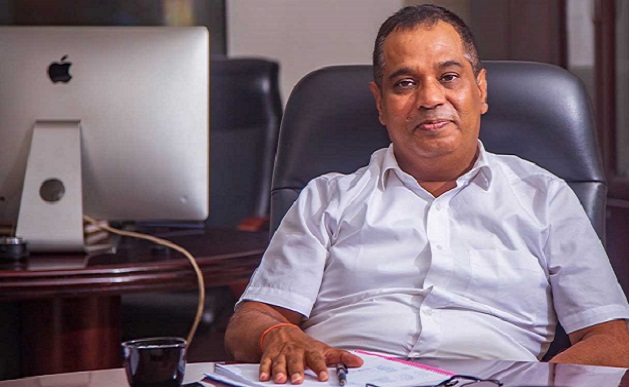
Sanjay Awasthi, the Tembo Steels (Uganda) Ltd founder and Chairman
HABARI DAILY I Kampala, Uganda I Surviving on scrap steel bars to feed their steel mills for years, Tembo Steels Uganda Limited officials are facing fresh scrutiny over allegations that they bribed Uganda Railways Corporation (URC) managers to accept a fraction of the value of railway materials recovered from the company’s premises.
Tembo Steels (U) Ltd has an installed production capacity of 1.8 million tonnes of steel products annually, making it one of Uganda’s largest steel manufacturers, with operations spread across its manufacturing facilities in Lugazi and Iganga.
The allegations resurfaced on Monday, November 23, 2026, when Members of Parliament sitting on Parliament’s Committee on Physical Infrastructure grilled Tembo Steels officials over the controversial acquisition of railway materials, demanding explanations about how the company ended up with government property and why it paid only about Shs520 million to settle a case involving materials reportedly worth billions of shillings.
The parliamentary interrogation brought renewed attention to one of the country’s controversial cases involving the alleged vandalism and theft of public infrastructure, as legislators questioned the company’s procurement practices, the conduct of URC officials and the circumstances surrounding the out-of-court settlement.
The controversy dates back to investigations in which joint security agencies and URC officials raided Tembo Steels’ facilities in Lugazi and Iganga, recovering 1,946 railway tracks and sleepers weighing approximately 270 metric tonnes.
The recovered materials were reportedly marked with URC identification symbols, raising questions about how they had found their way into the company’s stores.
According to the Auditor General’s 2021/22 report on URC, the recovered railway materials were valued at Shs12.39 billion, but the corporation subsequently entered into an out-of-court settlement with Tembo Steels on September 27, 2021, accepting approximately Shs520 million.
The Auditor General calculated that the settlement occasioned a government loss of at least Shs11.87 billion.
MPs question settlement arrangements
During Monday’s proceedings, Tembo Steels General Manager told legislators that the company had obtained the railway materials from scrap dealers identified as Umar and Miro, insisting that the company was not involved in vandalising railway infrastructure.
However, MPs Moses Attan Okia and James Waluswaka questioned why the company had failed to establish the origins of the materials before purchasing them.
The legislators were particularly concerned that the company’s procurement officers had accepted large quantities of railway steel from suppliers without establishing whether the materials had been lawfully acquired.
Available URC auction records indicated that Umar had legally purchased only 52 metric tonnes of railway materials, yet he reportedly supplied Tembo Steels with an additional 218 metric tonnes.
The discrepancy prompted MPs to question how the company could have accepted the additional materials without demanding documentation establishing their ownership.
Waluswaka reportedly demanded that the committee consider arresting the company’s General Manager and the two scrap dealers who had been summoned but failed to appear before the legislators.
The committee also questioned why Tembo Steels had sent its General Manager and a lawyer instead of the company’s Managing Director, with legislators insisting that the company’s top leadership should personally account for the transaction.
The General Manager, however, maintained that the company was innocent, arguing that it could not be held responsible for vandalism simply because railway materials had been found at its premises.
He also reportedly defended the company’s investment in Uganda, arguing that it had invested billions of shillings and created employment opportunities for Ugandans.
But committee chairman Mwiine Mpaka told the company’s representatives that their investment in Uganda did not exempt them from accountability.
The MPs also questioned why Tembo Steels had entered into a consent agreement under which it undertook to support a campaign against railway infrastructure vandalism, yet the circumstances surrounding the acquisition and settlement of the recovered materials remained contentious.
Allegations of collusion, financial loss
The latest parliamentary interrogation has revived questions about the conduct of URC officials who negotiated the controversial settlement with the steel manufacturer.
In his 2021/22 audit report, the Auditor General raised concerns about possible collusion and mismanagement of the legal proceedings involving companies found with stolen railway materials.
The report established that URC had suffered a combined compensation loss of Shs12.76 billion from settlements involving two steel companies.
In the Tembo Steels case, the corporation accepted Shs520 million against materials valued at Shs12.39 billion.
The Auditor General noted that the settlement payment was even lower than the estimated value of the 1,946 recovered railway materials, which stood at Shs8.76 billion.
“This led to a total compensation loss of UGX.12.76Bn from both companies, an indication of collusion and that the legal cases were mismanaged,” the report stated.
The Auditor General consequently advised URC’s management to review its out-of-court settlement procedures and ensure that they were transparent and verifiable.
He further recommended that where collusion was established, appropriate action, including recovery from responsible individuals, should be instituted.
Although allegations of bribery involving officials who negotiated the settlement have featured in the renewed controversy, the Auditor General’s report specifically identifies suspected collusion and legal mismanagement rather than establishing that particular officials received bribes.
The distinction raises the question of whether investigators have adequately examined possible financial inducements that could have influenced the settlement.
Citizens demand accountability
The revelations have also attracted public concern, particularly among citizens who believe that the theft of railway infrastructure has contributed to the deterioration of Uganda’s railway network.
Parliament Watch, a civic technology platform that monitors parliamentary proceedings, highlighted the controversy, drawing attention to the disparity between the value of the recovered materials and the amount accepted by URC.
The platform quoted Mpaka describing the settlement as embarrassing, questioning why a corporation entrusted with protecting public infrastructure could accept Shs520 million for materials valued at Shs12.39 billion.
“We are now looking for the materials,” Mpaka told Parliament while explaining the circumstances surrounding the settlement.
The statement has raised another concern: whether the railway materials recovered from Tembo Steels were subsequently returned to government or whether the company retained or processed them after the settlement.
The controversy is particularly significant because railway sleepers and steel tracks are essential components of the country’s transport infrastructure.
The Auditor General’s report further observed that the theft and subsequent sale of railway materials to steel manufacturing factories had resulted in losses to URC, increasing the cost of reconstructing railway lines.
Meanwhile, MPs have demanded explanations from Tembo Steels and URC officials, with the committee expected to pursue accountability for the disputed transaction.
The central question remains how 270 metric tonnes of government railway materials ended up in the stores of a private steel manufacturer and why the corporation accepted compensation representing only a fraction of their assessed value.
Two production units
According to company information, Tembo’s combined capacity covers several production units, ranging from iron ore processing and crude steel production to the manufacture of finished steel products for the construction and manufacturing industries.
The company’s production infrastructure includes an annual crude steel capacity of approximately 600,000 tonnes and Direct Reduced Iron (DRI) production capacity of 350,000 tonnes.
The latter comprises two production units, including a 250,000-tonne facility commissioned in January 2025 at Iganga, which expanded the company’s capacity to produce sponge iron, a key raw material in steel manufacturing.
Among its major product lines, Tembo has an estimated annual capacity of 300,000 tonnes for wire rods and related products, 150,000 tonnes for structural steel and approximately 120,000 tonnes for hot-rolled sheets.
Its product portfolio includes Tembo TMX thermal mechanically treated (TMT) reinforcement bars, wire rods, binding wire, nails, welding rods, wire mesh, BRC mesh, hollow sections, round and square tubes, angles, flat bars and C-channels.
These products serve construction and engineering companies, hardware dealers, manufacturers and individual customers.
The company’s integrated manufacturing process enables it to produce steel from iron ore through sponge iron production, melting, casting and rolling, adding value locally rather than relying entirely on imported finished steel.
Steel of Uganda+1
Tembo’s operations are supported by ISO 9001:2015 quality management certification covering its Lugazi and Iganga facilities.
Tembo Steels (U) Ltd
With its broad product range and installed capacity, the company occupies a significant position in Uganda’s steel manufacturing industry, supplying materials used in infrastructure development, housing, fabrication and industrial production.







About the Author