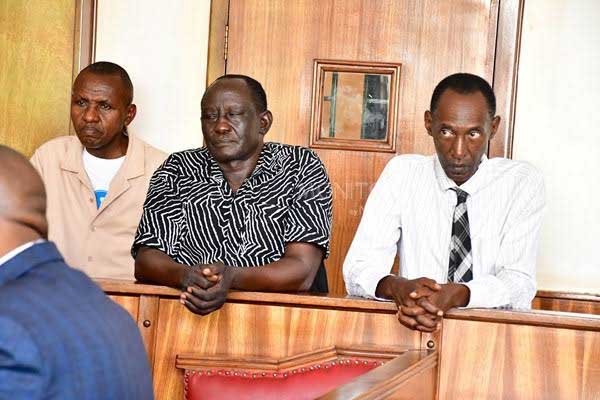


Paul Mackenzie in court
HABARI DAILY I Kampala, Uganda I Paul Mackenzie’s forty days are finally over, as a Kenyan court has convicted the controversial Good News International Church leader of manslaughter over the deaths of 123 adult followers who starved to death in Shakahola Forest in one of the country’s worst religious cult tragedies.
The verdict, delivered on Friday, November 27, 2026, by a court in Mombasa presided over by Magistrate Alex Ithuku, found Mackenzie responsible for directing his followers to undertake prolonged fasting between January 2021 and September 2023 in the belief that they would reach heaven and meet Jesus before the end of the world.
The conviction adds to a series of criminal cases against the self-styled pastor, whose teachings and activities led to the deaths of hundreds of people after he persuaded followers to abandon their normal lives and embrace extreme religious practices.

The court also convicted 29 other defendants, including Mackenzie’s wife, Rhoda Mumbua Maweu, of manslaughter, while 60 others were acquitted. However, prosecutors indicated that they intended to appeal against the acquittals.
The Director of Public Prosecutions described Friday’s decision as the final conviction in the cases against Mackenzie.
Mackenzie dictated how followers would die
In reaching its verdict, Magistrate Ithuku found that Mackenzie had systematically persuaded his followers to starve themselves to death in secluded sections of Shakahola Forest.
The court established that the pastor did not merely preach fasting as a religious practice but directed followers to continue abstaining from food until they died, promising that death would enable them to reach heaven and meet Jesus.
One of the most disturbing findings was that Mackenzie had established an order in which members of the cult were expected to die.
Children were to die first, followed by women and then men, with Mackenzie himself expected to be the last person to die.
The magistrate also found that Mackenzie directed followers to secluded fasting locations within the forest, where they could undertake the exercise away from public scrutiny.
The court further established that Mackenzie was involved in activities that followed the deaths of his followers, strengthening the prosecution’s case that he played a central role in the events leading to the mass deaths.
The prosecution argued that Mackenzie and his accomplices had acted together as part of an organised suicide pact, using religious teachings to convince followers that starvation was the pathway to salvation.
Defence argued victims fasted voluntarily
Mackenzie had denied the manslaughter charges, with his defence team arguing that the victims had voluntarily chosen to fast as part of their religious beliefs.
However, the court rejected the defence’s position, finding that the followers had been systematically persuaded to undertake the fatal exercise under Mackenzie’s direction.
His lawyer indicated that the defence intended to appeal against the manslaughter conviction following sentencing.
The latest conviction comes after Mackenzie and 28 others were earlier convicted of murdering 191 people, comprising 190 children and one adult, in the same Shakahola mass killing.
Earlier in November, Mackenzie was sentenced to 200 years in prison, comprising two consecutive 100-year terms, for the murders.
He was also convicted earlier in the week of assault causing actual bodily harm, five counts of cruelty to a child, engaging in organised criminal activity, radicalisation, facilitating the commission of a terrorist act and possessing an article connected with an offence under Kenya’s Prevention of Terrorism Act, 2012.
Popular preacher and mass murder suspect
Mackenzie established Good News International Ministries in 2003, gradually attracting thousands of followers through churches operating in different parts of Kenya.
His sermons were also broadcast through Times TV, a television station that helped extend his influence beyond his congregation in the coastal town of Malindi.
However, his teachings increasingly embraced extreme end-times messages, including claims that education was evil, healthcare contradicted religious doctrine and digital identity cards represented the mark of the devil.
After his main church closed in 2019, Mackenzie relocated to Shakahola Forest, encouraging his followers to join him in establishing a secluded religious community.
The community consisted of scattered mud houses within the vast forest, where followers were encouraged to embrace extreme fasting practices.
Dangers of religious extremism
The tragedy came to international attention in 2023 after authorities discovered shallow graves containing hundreds of bodies in Shakahola Forest, near Kenya’s Indian Ocean coast.
More than 400 bodies were eventually discovered, prompting one of the country’s most extensive investigations into religious extremism and criminal activities disguised as worship.
Post-mortem examinations established that many victims had died from starvation, while the condition of other remains made it difficult to establish the precise cause of death.
The discoveries also revealed the devastating impact on families. Stephen Mwiti, who lost all six of his children to the cult, previously welcomed Mackenzie’s murder conviction, saying he had only managed to recover and bury the remains of one of his children.
The deaths prompted President William Ruto to establish a commission of inquiry into the tragedy, although the commission was subsequently declared unconstitutional.







About the Author