
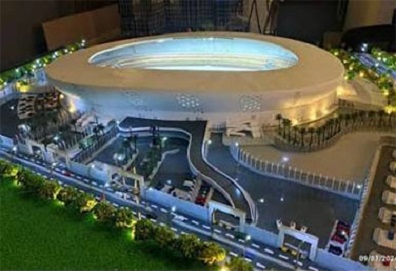
Graphic representation of Akii-Bua Olympic Stadium
HABARI DAILY I Kampala, Uganda I After almost 20 years of waiting, Lira City is finally seeing the long-promised Akii-Bua Olympic Stadium take shape, with construction now entering a critical final phase as Uganda races to prepare its infrastructure for the 2027 Africa Cup of Nations (AFCON).
The 20,000-seat multi-sport facility is now reported to be about 75 percent complete, with the contractor, SAMCO National Construction Company, pushing ahead with roofing, painting, exterior finishing and installation of spectator seats.
The progress marks a significant acceleration for a project that has been discussed for years but only moved into serious construction in recent years. The Shs470 billion facility was formally launched in 2025, with the Egyptian contractor initially working toward completion within a 20-month period.
Foundations to finishing works
The pace of construction has changed considerably since the beginning of the project.
By June 2025, the project was only about 10 percent complete. By March 2026, government officials were reporting completion rates of between 40 and 45 percent, while the main stadium structure had advanced considerably further.
In February, project managers said about 95 percent of the main structural works had been completed and that the stadium had reached the roofing stage.
The latest 75 percent overall completion figure therefore points to substantial progress on the wider complex, even as different components have advanced at different rates.
The main stadium bowl, VIP sections and major structural frameworks are largely in place. Workers are now concentrating on the less visible but equally important finishing and installation works.
These include roofing, painting, external finishes and the rolling installation of seats around the spectator stands. Uganda Radio Network reported in May that seat installation had already begun, alongside roofing and painting works.
Pitch infrastructure taking shape
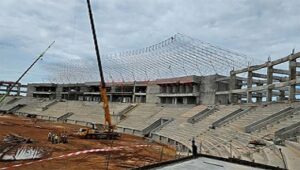
Structural works
Beyond the towering concrete and steel structure, underground works for the playing surfaces have also advanced.
The sub-surface drainage and underground systems serving the main football pitch and training grounds have been completed, clearing an important stage before the final playing surfaces and associated facilities are delivered.
The stadium is designed as a major multi-sport complex rather than simply a football ground. Once completed, it is expected to feature an eight-lane athletics track, indoor sports facilities, a swimming pool, training pitches and other supporting infrastructure.
The wider project also includes roads, utilities, ICT infrastructure, parking, accommodation and other facilities intended to make the complex capable of hosting major international competitions.
February 2027 deadline
The construction race has acquired greater urgency because Akii-Bua Stadium has been designated as a standby venue for AFCON 2027, which Uganda will co-host with Kenya and Tanzania.
Although earlier projections had suggested the stadium could be completed by late 2026, the contractor’s revised programme now points to February 2, 2027 for final completion.
That deadline leaves relatively little room for delays, testing, certification and preparations before the continental tournament.
The project’s schedule has already shifted from earlier expectations. In March, government officials said the contractor was ahead of schedule and targeting completion as early as December 2026.
However, the revised February 2027 handover date provides a more conservative completion target.
Symbol for Northern Uganda
For Lira and the wider northern region, the stadium represents more than Uganda’s AFCON preparations.
Named after John Akii-Bua, Uganda’s legendary Olympic champion who won the country’s first Olympic athletics gold medal at the 1972 Munich Games, the facility is expected to become a major sporting and economic landmark for Northern Uganda.
If SAMCO maintains the current construction momentum, Lira could enter 2027 with a modern sporting complex capable of hosting national, regional and continental events.
For a project that has been anticipated for nearly two decades, the decisive question is now no longer whether Akii-Bua Stadium will rise from the ground, but whether the remaining 25 percent of work can be completed, tested and handed over on time for Uganda’s biggest football assignment yet.







About the Author