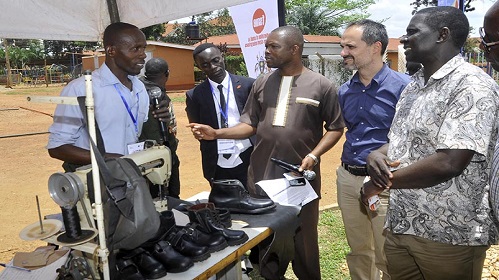
An exhibitor displays shoes at the Busoga Federation of Medium Small-Scale Enterprises (FMSME) exhibition at St. James church Jinja City. Photo by Wilfred Sanya
HABARI DAILY I Kampala, Uganda I The Belgian Government, through its development support arm – Enabel, has partnered with the Federation of Small and Medium-Sized Enterprises (FSME) to equip farmers and small businesses around Uganda, with skills to improve production, value addition, with an aim of gaining access to wider markets, including foreign ones.
The initiative, targeting creation of green jobs, value addition and stronger agricultural value chain, and implemented in partnership with the Ugandan government, seeks to create green and decent jobs for young people by strengthening micro, small and medium enterprises (MSMEs), particularly those operating in agriculture, fisheries, aquaculture and renewable energy.
The partnership was highlighted during the SME Business Exhibition Week, Busoga Region Edition, which was held recently at St James Church of Uganda in Jinja City, where farmers, entrepreneurs, financial institutions and government agencies gathered to showcase products, exchange knowledge and explore business opportunities.
Peter Okubar, project manager of the Enabel-supported We Work project at FSMSE, said the programme was designed to address unemployment by helping enterprises become more productive, competitive and sustainable.
“Basically, the purpose of the project is to create employment for young people by supporting micro, small and medium enterprises involved in different value chains,” Okubar said.
He identified aquaculture and fisheries, coffee, cocoa and renewable energy as the five core value chains being supported in Busoga.
The project is national in scope and is also being implemented in West Nile, the Rwenzori region and Kampala.
Farmers improve competitiveness
Okubar said the initiative has three key pillars, beginning with capacity building through training for selected small and medium-sized enterprises.
FSMSE is currently working directly with 21 enterprises, while Enabel supports other businesses through complementary interventions.
The second pillar is the MSME Week, an annual programme that provides businesses with opportunities to exhibit products, identify customers and establish relationships with potential partners.
Previously concentrated largely in Kampala, the exhibition has been decentralised to regional centres with Enabel’s support to bring services and opportunities closer to businesses outside the capital.
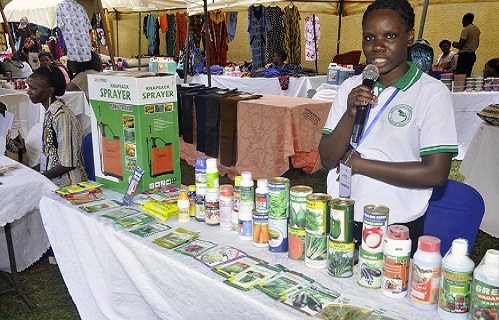
The third component includes business clinics and specialised training sessions, through which experts offer practical advice and help entrepreneurs address challenges affecting their operations.
At the Jinja exhibition, for instance, fisheries officials trained participants on aquaculture, enabling fish farmers and other value-chain actors to discuss production methods, inputs and the constraints affecting their businesses.
Okubar said the engagement was intended to extend beyond the exhibition through follow-up connections with district authorities, financial institutions and other service providers.
“This is not just an exhibition, but it is more than an exhibition in our view,” he said.
He estimated that about 200 exhibitors had participated in the Jinja event, with businesses from the targeted value chains represented.
The exhibition also provided opportunities for entrepreneurs to meet registration agencies and financial institutions that could help them formalise their operations and access credit.
Farmers urged to eye bigger markets
John Walugembe, FSMSE managing director, has consistently championed support for small businesses as a means of strengthening Uganda’s enterprise sector. He pointed out that the regional exhibitions provide a platform through which businesses can connect with potential buyers, financial service providers and organisations offering technical assistance.
“For farmers seeking to reach regional and international markets, the ability to produce consistent quantities of quality products remains essential,” he said during the Jinja exhibition.
Paul Balidawa, the Assistant Resident City Commissioner (RDC) for Jinja City, urged farmers to form groups, register their businesses and aggregate their produce to increase their bargaining power and meet market demand.
He said collective organisation would also help farmers overcome difficulties accessing finance, particularly where lenders require collateral that individual smallholders cannot provide.
“Let them make the different groups so that they can easily access funding from the financial institutions,” Balidawa advised.
He further encouraged farmers to formalise their businesses so they could market their products more effectively, including through digital platforms, and qualify for available support programmes.
Balidawa said aggregation would enable farmers to combine small quantities of produce from different locations into larger volumes capable of attracting buyers and sustaining commercial relationships.
He also emphasised value addition, explaining that businesses involved in different stages of production and processing could create complementary markets and improve the sustainability of agricultural enterprises.
Aquaculture empowers young people
Fisheries was among the value chains receiving particular attention during the exhibition, reflecting the economic importance of fish production and trade in the Busoga region.
Michael Walugada, the Senior Fisheries Officer, Jinja City used the event to engage farmers, hatchery operators, feed producers and manufacturers of other aquaculture inputs.
He encouraged fish farmers to form cooperatives, improve access to quality fish seed and affordable feed, and seek appropriate financing and technical guidance.
“Although we are faced with market access challenges facing pond fish farmers, including inadequate transport, limited cold-chain facilities and the distance between production sites and buyers, farmers have been able to organise themselves in groups and overcome them,” he said..
Walugada called for stronger linkages among producers, traders and transport providers to improve fish handling, aggregation and distribution.
He presented aquaculture as an alternative livelihood for young people, particularly as fishing activities become increasingly organised under government licensing and management measures.
“Masese in Jinja is an example of growing youth involvement in fish farming. We as a city encourage farmers to explore pond production, including catfish, where suitable.”
Taking initiative beyond Busoga
The Jinja exhibition marked the beginning of the regional rollout of the 2026 MSME Week programme.
According to Okubar, subsequent regional engagements are planned for Arua City on October 29 and 30, followed by an event in Fort Portal for the Rwenzori and neighbouring regions from November 2 to 6.
The programme is scheduled to culminate in a national exhibition for the Greater Kampala Metropolitan Area at UMA Showgrounds from November 19 to 21.
Through the exhibitions, business clinics and targeted training, the organisers hope to strengthen enterprise networks and improve access to essential business services.
“For Busoga’s farmers, the ultimate opportunity lay in translating the training and new connections into better production, value-added goods and reliable markets beyond their immediate communities,” said Walugembe.
Pamut Umut, the Intervetional Manager, Enabel Busoga, underscored the partnership between Enabel, FSMSE and the Ugandan government as a tool to make small enterprises stronger contributors to employment, sustainable livelihoods and Uganda’s wider economic development.







About the Author