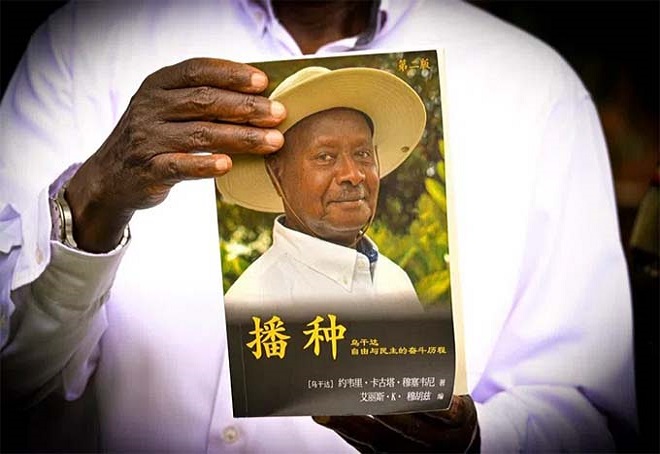
President Museveni receiving the Chinese version of his book at State House Nakasero recently
HABARI DAILY I Kampala, Uganda I The translation of Sowing the Mustard Seed into Chinese and its adoption in military academies marks a significant shift in the evolving relationship between Uganda and China—one that extends beyond commerce into the realm of ideas, leadership, and strategic thought.
The Chinese edition of the memoir by Yoweri Museveni was officially presented at State House Nakasero on April 22, 2026, in a ceremony led by Qiang Wenyu, Vice President of China North Industries Corporation, alongside Lt Gen James Mugira. While the event itself underscored diplomatic goodwill, the broader implications of the translation carry deeper strategic weight.
Originally published in 1997, the book chronicles Museveni’s journey from student activism to leading a five-year guerrilla war that culminated in the capture of power in 1986. Beyond its historical narrative, the autobiography lays out ideological foundations centered on patriotism, pan-Africanism, and socio-economic transformation—principles that have shaped Uganda’s governance for nearly four decades.
Its translation into Chinese opens a new channel for intellectual exchange between the two nations. For China, incorporating the text into military curricula signals a deliberate effort to study revolutionary movements and post-conflict state-building models from the Global South.
In doing so, Chinese institutions are not only examining Uganda’s unique historical trajectory but also broadening their understanding of leadership in non-Western contexts.
For Uganda, the move represents an opportunity to project its political and historical experiences onto a global stage. It positions the country as a contributor to international discourse on governance and development, rather than merely a recipient of foreign investment.
Analysts note that such recognition enhances Uganda’s soft power, elevating its influence in shaping conversations among emerging economies.
The importance of translation in this context cannot be overstated. By rendering the text accessible to Chinese readers, linguistic barriers that once limited engagement are removed, allowing deeper appreciation of Uganda’s political evolution. Translation transforms the book from a national memoir into a global reference point, enabling cross-cultural learning and dialogue.
Moreover, the development reflects a maturing Uganda–China partnership. Historically anchored in trade and infrastructure projects, the relationship is now expanding into education, military studies, and ideological exchange. This diversification signals a more balanced engagement, where knowledge-sharing complements economic cooperation.
The inclusion of the book in Chinese military academies also underscores the relevance of lived experiences in shaping modern strategic thinking. Museveni’s account of guerrilla warfare, leadership under pressure, and nation-building offers practical lessons that resonate beyond Uganda’s borders.
It joins a growing body of literature by National Resistance Army veterans, including works by figures such as Maj. Gen. Elly Kayanja and Maj. Gen. Pecos Kutesa, who have documented their perspectives on Uganda’s revolutionary struggle.
Ultimately, the translation of Sowing the Mustard Seed into Chinese is more than a literary milestone—it is a bridge between two nations seeking to understand each other at a deeper level. As Uganda and China continue to strengthen ties, the exchange of ideas and historical experiences may prove just as influential as the exchange of goods and capital.