
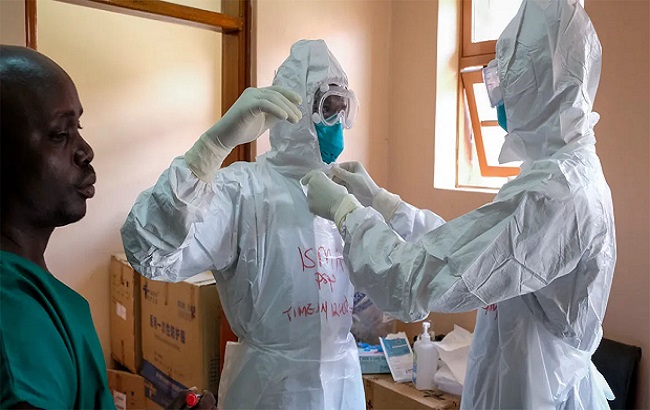
Health workers have been put on standby and others deployed countrywide
HABARI DAILY I Kampala, Uganda I The Ebola outbreak is continuing to trouble Ugandan authorities, leading to precautionary measures aimed at causing public meyhem and interrupting public life. Health authorities have henceforth placed 127 people under institutional quarantine following the confirmation of Ebola cases linked to an outbreak that originated in the neighboring Democratic Republic of Congo (DRC), as the government intensifies efforts to contain the deadly virus.
The Uganda Ministry of Health said the quarantined group consists mainly of health workers and individuals who came into contact with an infected Congolese national who later died at Kibuli Muslim Hospital in Kampala. The patient’s death marked the first fatality recorded in Uganda during the current outbreak.
Officials confirmed that Uganda has so far registered at least two confirmed Ebola cases and one death connected to the outbreak caused by the rare Bundibugyo strain of the virus. The World Health Organization (WHO) has since classified the outbreak as a serious public health concern, prompting heightened surveillance and emergency response measures across the country.
According to the Uganda Media Centre, the majority of those quarantined include medical personnel who treated the deceased patient, as well as the driver who transported the individual before admission to hospital. Authorities said the contacts are being monitored closely by specialized medical teams at an undisclosed facility within the Kampala Metropolitan area.
Home-based isolation implemented
Health officials emphasized that none of the individuals currently under quarantine has tested positive for Ebola.
The Ministry of Health has ruled out home-based isolation for this outbreak, ordering all identified contacts to undergo mandatory institutional quarantine for 21 days — the incubation period for the Ebola virus. Authorities say the measure is intended to minimize the risk of community transmission in densely populated urban areas.
As fears of further spread grow, the Ministry of Health has also issued sweeping new Standard Operating Procedures (SOPs) targeting public gatherings, places of worship, transport operations and burial ceremonies.
The new directives, issued through the ministry’s Department of Health Promotion, Education and Communication, require stricter screening, hygiene and distancing measures in locations considered high-risk for transmission.
Public events notification
Under the new regulations, organizers of mass gatherings — including political rallies, sports events, weddings, funerals and religious crusades — must notify district health authorities before holding any event.
The ministry stated that venues hosting large crowds must provide adequate sanitation facilities, including toilets and handwashing stations, while also establishing screening points and assigning health safety personnel to oversee compliance.
Anyone found with a body temperature exceeding 38 degrees Celsius during screening is to be isolated immediately and referred for further medical examination.
Event organizers have also been instructed to report suspected Ebola cases to authorities without delay and prevent unnecessary movement around individuals displaying symptoms until emergency response teams arrive.
Religious institutions have been directed to discourage physical contact among worshipers, including handshakes, hugging and other close-contact greetings that could facilitate the spread of the virus.
Religious leaders were specifically advised against laying hands on congregants during prayers, a practice common in many worship services across the country.
Worship centres cautioned
The ministry further instructed worship centres to isolate any person who develops Ebola-like symptoms during services and ensure thorough disinfection of contaminated surfaces.
Public transport operators and market authorities have also been placed under strict health directives. Open-air markets are now required to install handwashing facilities at entry points and regularly disinfect stalls, toilets and frequently touched surfaces.
Drivers, taxi operators, conductors and boda boda riders have been warned against transporting passengers showing signs of Ebola infection.
Burial protocols issued
Meanwhile, the government has announced strict burial protocols for suspected or confirmed Ebola victims, warning that bodies of infected persons remain highly contagious even after death.
Only trained burial teams will be permitted to handle and bury suspected Ebola victims under the new rules. Family members are prohibited from touching, washing or preparing bodies for burial.
Mourners have also been advised to avoid overcrowding, handshakes and physical contact during funeral ceremonies.
The Ministry of Health has urged the public to remain calm but vigilant and immediately report suspected Ebola cases through the toll-free hotline 0800-100-066 or by sending a free SMS to 6767.
Health officials say early detection, strict quarantine measures and public cooperation will be critical in preventing a wider outbreak in Uganda.