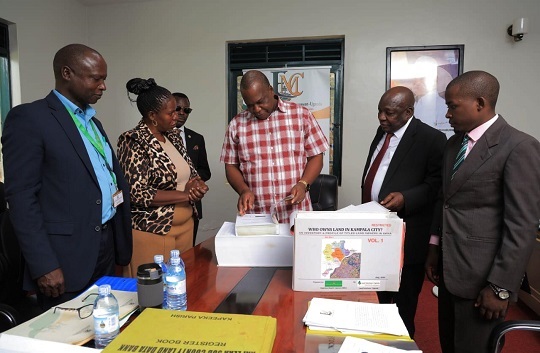
Rwot David Onen Acana II (C) with members of the center at Matugga
HABARI DAILY I Kampala, Uganda I The Paramount Chief of the Acholi, Rwot David Onen Acana II, has described Gen. Salim Saleh, whose real name is Caleb Akandwanaho, as a visionary leader and peacemaker for establishing the Equity Center for Land Management Uganda, an initiative seeking to resolve land conflicts through mediation and reconciliation rather than prolonged court battles.
Acana made the remarks during a recent visit to the centre at Matuga, where he commended Gen. Saleh for championing an approach that seeks to transform land disputes into opportunities for peaceful coexistence, investment and economic development.
The centre provides a platform for landlords and occupants of disputed land to negotiate mutually acceptable solutions while protecting their interests and exploring ways of unlocking the economic value of their properties.
Acana said the initiative offered valuable lessons for communities across Uganda, particularly the Acholi sub-region, where land disputes have increasingly become a concern as more people move into the area to take advantage of its fertile soils and agricultural potential.
He observed that land was not merely a source of livelihood but also an important economic asset whose productivity could be undermined by persistent conflicts and uncertainty over ownership and occupancy.
Acholi Seeks to Upgrade Land Dispute Resolution
Acana said Acholi communities already had customary mechanisms for resolving land conflicts but needed to strengthen them by incorporating professional expertise and modern land management practices.
“In Acholi, we have a similar process of managing land conflicts, but this is only composed of traditions, and we need to upgrade like this centre so that we can bring on board experts as well,” Acana said.
He explained that changing patterns of land ownership and increasing interest from people outside the region had made disputes more complicated, requiring approaches that combine traditional knowledge with technical and professional guidance.
According to Acana, communities that previously approached land ownership and access informally were increasingly facing competing claims as new stakeholders entered the region.
He disclosed that stakeholders from Acholi had already visited the centre to study its model, particularly its emphasis on settling disputes without necessarily resorting to conventional courts.
The cultural leader pledged to strengthen collaboration with Professor John Kigula, the centre’s executive director, to explore how the initiative could be adapted to address the region’s specific land challenges.
Such cooperation, he said, would help communities develop practical ways of resolving disputes before they escalate into expensive legal battles or undermine relationships between landlords and occupants.
Gen. Saleh’s Experience Inspired Initiative
Sylvia Muwebwa Ntambi, the centre’s deputy executive director and director of finance and administration, said the Equity Center for Land Management Uganda officially opened its doors on July 3, 2026.
She explained that the initiative was established to help people occupying disputed land find peaceful and sustainable solutions to their conflicts.
According to Ntambi, the centre originated from a pilot project in Kapeeka Sub-county after Gen. Saleh himself became involved in historical land disputes and was labelled a land grabber.
The experience prompted him to champion an alternative approach based on mediation and reconciliation, seeking to resolve competing claims without unnecessary confrontation.
The Kapeeka pilot handled 526 cases and amicably resolved 356 of them, demonstrating the potential of negotiated settlements in addressing land conflicts.
The project also brought together 1,250 landlords and 7,477 bibanja holders across 16 land blocks, illustrating the scale of disputes that can arise where ownership and occupancy interests overlap.
The centre is seeking to build on this experience by encouraging dialogue, informed decision-making and agreements that allow communities to live peacefully while making productive use of their land.
Centre Warns Against Misleading Investment Deals
Despite welcoming investment as a way of unlocking the value of land, Acana cautioned communities against unscrupulous middlemen who introduce purported investors without adequately explaining the proposed arrangements.
He said some communities expected immediate cash payments whenever investment opportunities were presented, yet certain projects required time before generating financial returns.
Acana stressed that transparency and proper engagement were essential to ensuring that landowners and occupants understood the terms, obligations and implications of investment agreements before committing themselves.
He warned that inadequate information could leave communities vulnerable to arrangements they did not fully understand, potentially creating further disputes instead of resolving existing ones.
The centre’s approach therefore places importance on informed negotiations, helping parties understand their interests and reach agreements that can support peaceful coexistence and sustainable investment.
Professor Kigula thanked Acana for visiting the centre, saying it was established to help people living on disputed land resolve their differences peacefully.
Other officials present during the visit included Dr. Pascal Wathum Odoch, director of research and programmes; Joel Ssebayiga, liaison officer; Baker Ntale, land advisory officer; and Major Herbert Ndiwalana, also a liaison officer.
Acana heads Ker Kwaro Acholi, the central customary institution based in Gulu. He was selected by 57 Acholi clan chiefs in 2002 and officially enthroned in January 2005, succeeding his late father, Rwot Justine Achana.
His visit signals an opportunity for cooperation between customary institutions and professional land management initiatives as communities seek solutions to disputes that affect livelihoods, investment and social cohesion.







About the Author