
Tesla’s New Roadster Takes Flight After Nearly a Decade of Delays
HABARI DAILY I Kampala, Uganda I Expecting heaven on earth, Elon Musk, the world’s richest man, got the reverse when he suffered the biggest wealth loss globally after his fortune plunged by $20 billion following the unveiling of Tesla’s futuristic Roadster, which he described as a “flying car”.
Musk’s fortune fell by 2.11 per cent to $925 billion, according to real-time data from Forbes, as shares of his electric vehicle manufacturer, Tesla, and aerospace company, SpaceX, came under pressure.
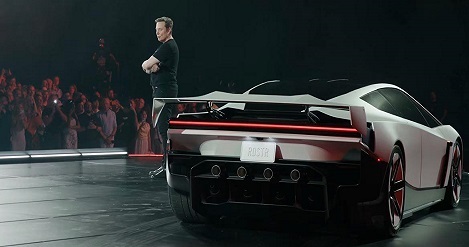
The decline came amid investor scrutiny of Tesla’s latest technological spectacle, which featured a driverless two-seater sports car performing dramatic manoeuvres involving a steep ramp, an upside-down position and an aerial flip before landing using jets of air.
Although the demonstration showcased Musk’s ambition to redefine transportation, the market reaction suggested that investors remain more concerned about commercial returns and the company’s financial performance than futuristic displays.
Tesla shares dropped 1.3 per cent on Thursday in United States trading and had lost 4.9 per cent over the preceding five days. The company’s stock was down 17 per cent since the beginning of the year.
SpaceX, Musk’s privately held rocket company, also recorded a 2.3 per cent decline in its shares, taking its year-to-date losses to nearly eight per cent.
The simultaneous declines in the valuations of the two companies contributed to the reduction in Musk’s personal fortune, which is heavily tied to his business interests.
The Roadster demonstration nevertheless generated excitement, with Musk presenting the vehicle as an example of what could emerge when automotive engineering is combined with rocket technology.
The car uses 10 nozzles and what Musk described as “ultra high-pressure air tanks” to propel itself and accelerate rapidly on the ground, according to global media channels.
During the demonstration, the vehicle was shown climbing a steep ramp, hanging upside down, flipping in the air and landing with the assistance of air jets.
Musk claimed the Roadster could accelerate from zero to 60 miles per hour, equivalent to 96 kilometres per hour, in less than a second, an extraordinary performance figure that would place it among the fastest accelerating vehicles if achieved under production conditions.
The vehicle is expected to enter mass production in 2028, although Tesla has faced repeated delays in delivering the Roadster since first announcing plans for the model.
Musk described the technology as “the results of what happens when you have a collaboration with the world’s best car company and the world’s best rocket company”.
The unveiling offers Tesla a high-performance flagship vehicle at a time when the company is increasingly shifting its strategic focus towards self-driving technology and robotics.
However, the timing has raised questions about whether the spectacle can translate into tangible commercial benefits, particularly as investors await Tesla’s third-quarter results.
According to Reuters, the financial results are expected to be more consequential for investors than the Roadster unveiling, as markets assess the company’s performance and prospects.
Some analysts have also questioned the immediate commercial value of the demonstration.
Gene Munster, managing partner at Tesla investor Deepwater Asset Management, described the unveiling on social media platform X as “an engineering flex with no commercial value beyond embarrassing traditional car makers”.
Others believe the vehicle could strengthen Tesla’s brand by giving it a high-performance model capable of showcasing its technological capabilities.
Morningstar analyst Seth Goldstein said in a note last month that Tesla currently lacked a flagship luxury performance vehicle designed to demonstrate its engineering prowess.
“Tesla does not currently have a halo car, or high-performance luxury vehicle designed to showcase an automaker’s best engineering and technology. The Roadster will be Tesla’s new halo car,” Goldstein said.
The original Roadster, launched in 2008 and sold until 2012, was Tesla’s first electric vehicle. Built using a Lotus Elise chassis, it helped challenge perceptions that electric cars could not deliver impressive performance.
Tesla subsequently expanded its range to include the Model S and Model 3 sedans and the Model X and Model Y sport utility vehicles, establishing itself as a major force in the global electric vehicle industry.
The latest Roadster reveal underscores Musk’s continued push to combine ambitious engineering with commercial innovation. However, his latest wealth loss highlights the financial risks associated with his sprawling business empire, where investor confidence can shift despite headline-grabbing technological advances.







About the Author