
Mahamat Said Abdel Kani
The International Criminal Court (ICC) has convicted former Central African Republic rebel commander Mahamat Said Abdel Kani on four counts of crimes against humanity, including torture and unlawful imprisonment, over his role in the brutal treatment of detainees during the country’s 2013 civil war.
The 56-year-old former commander of the mainly Muslim Seleka rebel group was found to have overseen beatings, torture and other forms of mistreatment while serving as head of a feared detention facility in the capital, Bangui.
Presiding Judge Miatta Maria Samba said Said was involved in the interrogation and mistreatment of detainees and was present when some prisoners were being tortured.
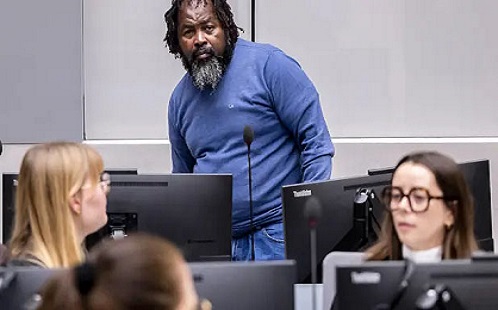
Said, wearing a blue sweatshirt and jeans, shook his head several times in the courtroom as Judge Samba read out details of the crimes.
The court, however, acquitted him of three counts of war crimes. His sentence will be delivered at a later date.
Torture at detention centre
The convictions centred on crimes committed at the Central Office for the Repression of Banditry, known by its French acronym OCRB, where detainees were subjected to severe physical abuse and degrading conditions.
According to the ruling, one of the frequently used torture methods was “arbatachar”, in which prisoners had their hands, elbows and feet tightly tied together behind their backs.
Other detainees were beaten with ropes and whips and subjected to water being poured over them, the court heard.
Said was also found responsible for the detention of some prisoners in a cramped underground cell located beneath his office.
Judge Samba said the cell had no sanitary facilities and was dark, dirty, poorly ventilated and severely overcrowded.
“Detainees had to urinate and defecate inside the underground cell,” she said, describing the floor as being covered in waste and the environment as smelling of faeces and urine.
The judges also acknowledged the lasting physical and psychological effects of the abuse on victims, their families and their lives.
One victim told the court that he had been “completely unbalanced” and that his life had been “completely destroyed” by the mistreatment he suffered.
Seleka rebellion plunged CAR into war
Said was a senior commander in the Seleka rebel movement, which overthrew President Francois Bozize in 2013, triggering a devastating conflict in the Central African Republic.
The predominantly Muslim Seleka rebellion was followed by the emergence of Christian and animist militias known as the anti-Balaka, who fought against the rebels and sought to regain power.
The conflict left thousands of people dead and was accompanied by allegations of widespread war crimes and crimes against humanity by fighters on both sides.
French troops, operating under a United Nations mandate, intervened from 2014 as international efforts sought to restore security in major population centres.
The country has since achieved relative stability following a 2019 peace agreement signed in Khartoum, although the legacy of the conflict remains significant.
ICC pursues both sides of conflict
Said’s conviction comes as the ICC continues prosecuting individuals accused of atrocities committed during the CAR conflict.
Last year, the court convicted two senior anti-Balaka figures, former sports minister Patrice-Edouard Ngaissona and former parliamentarian Alfred Yekatom.
Yekatom was sentenced to 15 years in prison for 20 war crimes and crimes against humanity, including murder and torture, while Ngaissona received a 12-year sentence for 28 counts.
Established in 2002, the ICC is the world’s only independent permanent tribunal with jurisdiction to prosecute individuals accused of genocide, crimes against humanity, war crimes and the crime of aggression.
For Said, Wednesday’s conviction establishes criminal responsibility for the abuse of detainees during one of the darkest periods in the Central African Republic’s recent history, although the court will determine his punishment at a later stage.