
Museveni Endorses Muhoozi For 2031 Presidency, Citing Four Decades Of Preparation
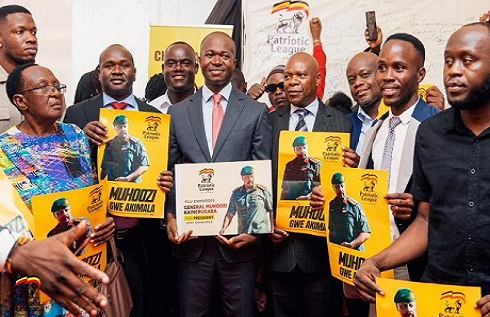
PLU supporters with placards supporting Gen Muhoozi’s presidential bid today, September 1st 2026
HABARI DAILY I Kampala, Uganda I President Yoweri Museveni has agreed to endorse his son, Gen Muhoozi Kainerugaba, for the presidency in the 2031 General Election, a development that could reshape Uganda’s political landscape and intensify debate over the country’s succession after Museveni.
The endorsement was announced on September 1, 2026 by Kasambya County MP Daudi Kabanda during a press conference at the Patriotic League of Uganda (PLU) offices, where he said the President had approved the ambitions of his son, who is also the Chief of Defence Forces (CDF) and chairman of the PLU.
Kabanda told journalists and Members of Parliament that Gen Kainerugaba had confirmed his intention to contest for the presidency in 2031.
“General Muhoozi Kainerugaba has told me to inform you that he will run for President 2031–2036,” Kabanda said.
He then disclosed that Museveni had agreed to back the bid.
“I would like to also let you know that His Excellency the President has promised to endorse Afande MK come the next general elections in 2031,” he said.
The announcement follows Gen Kainerugaba’s declaration last week that he intends to seek Uganda’s highest political office.
“I will stand for the highest office in the land in 2031. And we will win by the grace of Almighty God,” Kainerugaba wrote on X.
Museveni’s decision to endorse his son is being presented by his allies as the culmination of years of preparation rather than an abrupt succession arrangement. According to the explanation given by Kabanda, the President considers Muhoozi one of the most prepared people to take over the leadership of Uganda because of his long exposure to the country’s governance and political affairs.
Muhoozi, Museveni’s eldest son, has spent about four decades closely observing Uganda’s political and security environment, having grown up during his father’s long tenure in power and subsequently built a career in the Uganda People’s Defence Forces.
The argument advanced by Museveni’s camp is that this prolonged exposure has given Muhoozi an understanding of the complexities of governing Uganda, including the political, economic and security challenges facing the country.
The endorsement also has a political dimension within the ruling National Resistance Movement (NRM). Supporters of the move argue that openly settling on a preferred successor could help prevent competing factions from emerging within the ruling establishment as the 2031 election approaches.
The succession question has increasingly become a subject of political discussion as Museveni, who has ruled Uganda since 1986, continues to dominate the country’s political landscape.
The relationship between father and son has also been marked by political reciprocity. Muhoozi had previously expressed presidential ambitions for the 2026 election but subsequently stepped aside and backed his father’s continued leadership.
Museveni’s reported decision to actively support his son’s 2031 campaign could therefore be viewed by supporters as a continuation of that political alliance. Reports have indicated that the President could play an active role in managing and supporting the campaign.
The prospect of Muhoozi succeeding his father, however, is likely to generate significant controversy.
Opposition politicians and other critics have long expressed concern that the increasing political prominence of members of the Museveni family points towards a dynastic transfer of power. They argue that formally endorsing Muhoozi would strengthen perceptions that political succession is being determined within the ruling family rather than through an open contest among competing political forces.
There are also concerns about the relationship between Muhoozi’s political ambitions and his current position as CDF. Critics question whether a serving military commander seeking the presidency could create tensions around the separation between military institutions and partisan politics.
For supporters, however, Muhoozi represents a potential generational transition. They argue that a younger leader could bring new energy to government and confront long-standing challenges, including corruption, unemployment and institutional weaknesses.
The endorsement also comes at a time when Muhoozi has become increasingly vocal on national political issues, moving from the military establishment into an increasingly prominent political role through the PLU and his public statements.
About the Author