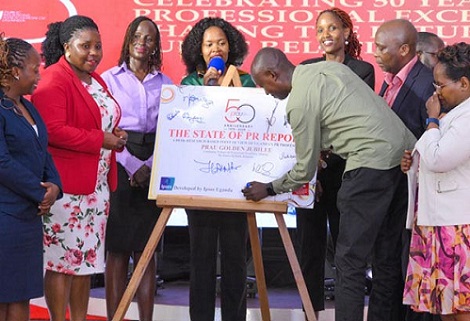
Rusoke Kituuma, the Uganda Police Force Spokesperson signing on the launch board of the state of PR report in Uganda developed by Ipsos. Looking on is PRAU President Irene Nakasiita (2nd Left) and other officials at the PRAU at 50 summit held at Source of the Nile Hotel in Jinja
HABARI DAILY I Kampala, Uganda I President Yoweri Museveni has congratulated the Public Relations Association of Uganda (PRAU) on marking 50 years of existence, highlighting the critical role of professional communication in nation-building as the association unveiled a landmark report assessing the state and future of public relations in Uganda.
The President’s message was delivered by Joyce Juliet Nabbosa Ssebugwawo, Minister of State for ICT and National Guidance, during the launch of PRAU’s Golden Jubilee Conference at Source of the Nile Hotel in Jinja City.
The conference, which forms part of a week-long summit running until October 23, 2026, has brought together public relations practitioners, industry leaders and other stakeholders to reflect on the profession’s achievements, challenges and prospects for the next 50 years.
The highlight of the celebrations was the unveiling of a book titled State of the PR Profession in Uganda: A Desk Research-Based Point of View of Uganda’s PR Profession, prepared by Ipsos Uganda. The publication is expected to serve as a baseline assessment to guide the future development of public relations in the country.
“Reaching 50 years of existence is no small achievement. It is a testament to resilience, adaptability and the critical role that professional communication plays in nation-building,” Museveni said.
The President emphasised the importance of communication in explaining government programmes, engaging citizens and ensuring that information about national priorities reaches the public.
He also challenged practitioners to communicate accurately and responsibly, particularly as institutions implement policies and development programmes.
“There is no point in immunizing people against diseases while leaving them vulnerable to confusion and misinformation,” Museveni said, underscoring the need to protect the public from misleading information through credible communication.
The message comes at a time when public relations is increasingly expected to extend beyond issuing press releases and securing media coverage to shaping institutional decisions, managing reputations and building public trust.
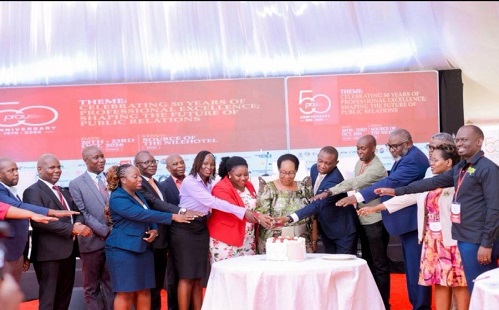
Joyce Juliet Nabbosa Ssebugwawo (M), the Minister of State for ICT and National Guidance joins PRAU members to cut cake in commemoration of 50 years of existence, during a colorful function held at Source of the Nile Hotel in Jinja
The Ipsos report is organised around three themes: Foundation, Friction and the Future. Together, they examine the profession’s evolution from basic media relations and publicity into a strategic management function expected to influence decision-making and contribute to organisational performance.
Ruth Ruigu, Country Manager at Ipsos Uganda, said the research was intended to reflect on the profession’s progress while identifying challenges and opportunities that could shape its future.
“Foundation gives us pride. Friction gives us learning. Future gives us possibility,” Ruigu said.
The assessment draws on desk research, Ipsos research and conversations with seven Ugandan public relations practitioners. Although it is not nationally representative, the report provides insights into the profession’s development and identifies areas requiring attention.
One of the central challenges identified is the difficulty practitioners face in demonstrating the value of public relations beyond traditional indicators such as press cuttings, media mentions and publicity generated.
The report calls for improved measurement of communication outcomes, stronger professional capabilities and greater recognition of public relations as a contributor to institutional performance, stakeholder confidence and organisational objectives.
For practitioners, the findings could strengthen efforts to secure a place in executive management and boardrooms by demonstrating how communication strategies contribute to business outcomes and long-term reputation.
The report also examines the growing influence of artificial intelligence (AI) in communications. It indicates that 74.1 per cent of respondents believed AI enhances, rather than replaces, human professionals, highlighting the importance of combining technological innovation with human judgement and expertise.
The changing media landscape also features in the assessment. According to the Ipsos 2026 Wave 3 National Audience Measurement Survey (NAMS) Quarterly Tracker, radio has the highest reach among active media users at 82 per cent, followed by television at 44 per cent, the internet at 33 per cent and newspapers at nine per cent.
These findings underline the importance of understanding audience behaviour and selecting communication channels according to the needs of different groups.
Delivering a virtual keynote address, Professor Michele Mekeme of the African Public Relations Association challenged practitioners to become more involved in shaping institutional decisions instead of merely publicising them after they have been made.
She said strategic influence, credibility and trust would remain central to the profession’s future.
Mekeme also linked effective public relations to Africa’s economic transformation, including opportunities arising from the African Continental Free Trade Area (AfCFTA).
“Credible communication and reputation management are vital in building confidence among citizens, businesses, investors and other stakeholders,” she said.
The summit also provided an opportunity for former PRAU leaders to reflect on the association’s journey and the changing demands of the profession.
During a panel discussion moderated by former president Tina Wamala, former presidents Cynthia Mpanga and Stephen Mwanga joined current president Irene Nakasiita to discuss the evolution of public relations in Uganda.
Mpanga described her relationship with the profession as a personal passion for communication and storytelling, saying, “For me, PR is a hobby.”
Mwanga reflected on the transition from a profession largely associated with media relations and press cuttings to one increasingly expected to understand organisational objectives and demonstrate measurable results.
Nakasiita drew on her experience at the Uganda Red Cross Society, where communication campaigns and media relations helped address leadership challenges and rebuild public confidence. Her experience illustrated the role public relations can play in restoring trust, maintaining donor relationships and improving an organisation’s public image.
Opening the Golden Jubilee celebrations, Nakasiita paid tribute to PRAU founder, the late James R. Mutabaazi, former presidents and members of the association’s Governing Council for laying the foundation for the profession’s growth.
She said the anniversary was an opportunity to celebrate past achievements while preparing practitioners for technological change and emerging demands.
“Public Relations is about building relationships, reputation and partnerships that bring mutual understanding. It is the heart, not just the Press Release,” Nakasiita said.
She thanked PRAU members and partners for supporting the association’s mission of advancing and professionalising public relations in Uganda.
The celebrations will also feature the 10th PRAU Excellence Awards, which will recognise achievements across public relations and communications, alongside knowledge-sharing sessions and networking opportunities.







About the Author