

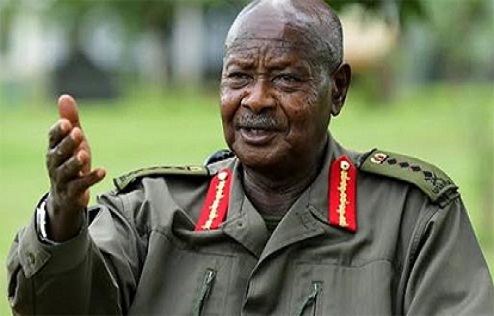
President Museveni
HABARI DAILY I Kampala, Uganda I President Yoweri Museveni has warned that corrupt and non-patriotic individuals have infiltrated the Uganda People’s Defence Force (UPDF) and other security agencies, accusing them of committing crimes with impunity while shielding fellow offenders from justice.
In a lengthy statement responding to journalist Andrew Mwenda’s commentary on Stephen Nuwagaba, Museveni said the greatest threat facing Uganda is not individuals portrayed as infiltrating State House, but rather compromised security personnel who have undermined the integrity of the country’s defence and intelligence institutions.
The President said the National Resistance Movement (NRM), the National Resistance Army (NRA) and the UPDF have always emerged victorious in defending Uganda, but acknowledged that some individuals had exploited the institutions for personal gain.
“However, the NRM/NRA/UPDF had been infiltrated by some corrupt and non-patriotic elements that were committing crimes with impunity,” Museveni stated, adding that this explained why he had recently welcomed the firmness with which security agencies were beginning to confront impunity within their own ranks.
Even as he called for accountability, Museveni cautioned security agencies against violating the law while pursuing criminals.
Fight against impunity
He stressed that the fight against impunity should never involve torture, extrajudicial killings or other unlawful acts.
“Nevertheless, the UPDF and the other security forces in fighting impunity, they should not commit their own crimes such as torture, extra-judicial killings,” he said, arguing that such practices are immoral, ideologically wrong and strategically counterproductive.
The President linked his concerns to the case of Stephen Nuwagaba, whom he described as a victim of torture and maiming allegedly inflicted by elements within the security services.
According to Museveni, Nuwagaba sought refuge under his protection after being threatened with death, forcing him to arrange medical treatment in Uganda and abroad.
He said some of the officers allegedly involved are already facing court proceedings, although he did not disclose the details of the cases.
Rogue officers are numerous
Museveni argued that the actions of rogue officers betray the sacrifices made during Uganda’s liberation struggle.
He recalled the execution of members of the Front for National Salvation (FRONASA) under Idi Amin and the atrocities committed during the Luweero war, saying those who fought for Uganda’s freedom did not sacrifice their lives so that citizens could once again face torture and abuse at the hands of state agents.
Beyond individual acts of abuse, Museveni accused some security officials of deliberately suppressing intelligence, protecting criminals and preventing information from reaching senior leaders.
“The reality on the ground is that the main problem of Uganda is not Nuwagaba seizing State House and the Security Forces but the criminals, including some in the Security Forces and other organs, that have been blocking the flow of information about the criminals, covering them up and ensuring information does not reach leaders like the President,” he said.
National security concern
The President further revealed that corruption and compromised personnel within intelligence structures remain a significant national security concern.
While acknowledging that Uganda invested heavily in training intelligence officers in agencies such as the Internal Security Organisation (ISO), External Security Organisation (ESO), military intelligence and the Police, Museveni said some officers had abandoned their patriotic duty.
“However, some security personnel have become corrupt or have been compromised by the enemy. This is, actually, the main problem of the country,” he said.
NRA liberation struggle tactics
Museveni contrasted today’s challenges with the intelligence methods employed during the NRA liberation struggle, explaining that military operations combined human intelligence and signals intelligence to achieve battlefield success.
He rejected suggestions that informal intelligence networks are outdated, arguing that they remain essential whenever formal institutions fail to perform their responsibilities.
According to the President, informal intelligence has helped expose corruption inside State House, uncover criminal networks and support sensitive investigations that formal structures had failed to resolve. He cited allegations involving corrupt officials accused of extorting money from citizens seeking access to State House







About the Author