
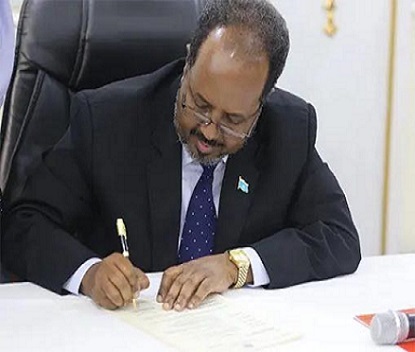
The Somali President Hassan Sheikh Mohamud signs the AfCFTA Agreement into law
HABARI DAILY I Kampala, Uganda I Somalia has become the newest country to join the African Continental Free Trade Area (AfCFTA), a milestone expected to unlock preferential access for its businesses to a continental market worth an estimated $3.4 trillion and comprising more than 1.4 billion consumers, while positioning the Horn of Africa nation for greater industrialization, investment and export-led growth.
President Hassan Sheikh Mohamud formally signed the AfCFTA Agreement into law following its ratification by the Federal Parliament, completing Somalia’s accession to Africa’s flagship trade framework and marking a significant step in the country’s economic transformation.
The move makes Somalia part of what is widely regarded as the world’s largest free trade area by the number of participating countries, reinforcing the African Union’s long-term vision of creating a single market that promotes the free movement of goods and services, expands investment and strengthens economic cooperation across the continent.
According to Somalia’s Ministry of Commerce and Industry, the presidential assent now enables the country to deposit its Instrument of Ratification with the African Union Commission, completing the formal process of joining the continent-wide trade bloc.
Somalia’s businesses to eat big
For Somali businesses, the implications are potentially far-reaching. Membership grants manufacturers, exporters, cooperatives and investors preferential access to a vast African market, creating new opportunities for trade while reducing or eliminating tariffs that have traditionally constrained cross-border commerce.
Government officials believe the agreement will significantly boost Somalia’s exports, particularly livestock and other locally produced goods, while encouraging value addition, industrial development and economic diversification after decades of conflict and reconstruction.
Commerce and Industry Minister Gamal M. Hassan described the country’s entry into AfCFTA as a defining moment in Somalia’s economic history.
“Today marks a turning point in Somalia’s economic history. By joining the African Continental Free Trade Area, Somalia is opening its doors to the world’s largest free trade area and positioning our private sector to compete, innovate, and prosper across Africa,” Hassan said.
He emphasized that the significance of the agreement extends well beyond tariff reductions.
Strategic platform for industrialization
“This is not simply a trade agreement—it is a strategic platform for industrialization, value addition, investment, and inclusive economic growth. The Ministry is fully committed to working with the private sector to ensure Somali businesses seize every opportunity that this landmark agreement presents,” he added.
Analysts say the agreement offers Somalia an opportunity to integrate more deeply into continental value chains while reducing dependence on a limited number of export destinations.
By opening access to a single African market, Somali enterprises are expected to benefit from greater economies of scale, increased competitiveness and improved opportunities to attract regional investment.
The agreement is also expected to stimulate private-sector expansion and create employment opportunities, particularly for Somalia’s youthful population, which has long faced limited formal employment prospects.
Beyond commercial opportunities, AfCFTA membership will require Somalia to undertake significant institutional reforms.
The Ministry of Commerce and Industry has announced that it will spearhead implementation by aligning national tariff schedules with AfCFTA requirements, developing modern trade instruments and conducting nationwide awareness campaigns to prepare traders, cooperatives, small and medium-sized enterprises (SMEs) and exporters for participation in the continental market.
These reforms are expected to modernize Somalia’s trade systems while improving regulatory efficiency and strengthening the country’s capacity to compete within Africa’s increasingly integrated economy.
Somalia’s accession also carries broader regional implications.
Economic ties across Horn of Africa
As one of the newest members of the continental free trade arrangement, the country is expected to strengthen economic ties across the Horn of Africa while complementing its recent participation in other regional economic initiatives.
Greater regional integration could improve cross-border trade, encourage investment in transport and logistics, and create stronger commercial links with neighboring economies.
The African Continental Free Trade Area itself represents one of Africa’s most ambitious economic integration projects.
Established under the African Union, the agreement seeks to increase intra-African trade by reducing tariffs and other trade barriers while strengthening regional value chains, accelerating industrialization and promoting sustainable economic growth.
Supporters believe expanding trade among African countries will reduce reliance on overseas markets, improve economic resilience and enable the continent to retain greater value from its natural resources through local manufacturing and processing.
However, economists caution that the full benefits of AfCFTA will depend largely on implementation.
Heavy infrastructure investment
While preferential market access creates new commercial opportunities, member states must invest heavily in transport infrastructure, efficient customs systems, digital connectivity and regulatory reforms to facilitate seamless trade across borders.
Addressing non-tariff barriers, improving border procedures and ensuring that SMEs can participate meaningfully in continental trade will also be critical if countries are to maximize the agreement’s economic potential.
For Somalia, maintaining peace, political stability and institutional capacity will remain essential ingredients for translating AfCFTA membership into tangible economic gains.
Continued collaboration with other African governments and sustained investment in productive sectors will determine whether Somali businesses can fully capitalize on access to one of the world’s largest integrated markets.
Even so, Somalia’s accession represents another important milestone in Africa’s broader ambition to build a more connected, competitive and prosperous continent.
As implementation begins, Somali exporters, manufacturers and entrepreneurs now have an unprecedented opportunity to reach millions of new consumers, attract investment and contribute to the country’s long-term economic transformation while participating in a continental market designed to unlock Africa’s collective economic potential.
AfCFTA Is Africa’s key to Prosperity
AfCFTA is increasingly being hailed as Africa’s most ambitious economic integration initiative, with the potential to transform the continent into a globally competitive economic powerhouse while lifting millions of people out of poverty.
Bringing together 54 African countries into a single market of more than 1.4 billion people with a combined Gross Domestic Product (GDP) exceeding $3.4 trillion, AfCFTA seeks to remove trade barriers, encourage industrialization and strengthen economic cooperation among member states.
Economists believe the agreement could significantly raise incomes across Africa by expanding opportunities for businesses to sell their goods and services beyond national borders. By opening markets and reducing tariffs on most products traded within Africa, the agreement is expected to stimulate investment, increase production and create millions of new jobs for both women and men.
Uganda businesses to eat big
Uganda stands to gain significantly from the AfCFTA, alongside Somalia and 53 other African countries. Projections show expanded export opportunities, stronger economic growth and greater access to markets across Africa, although infrastructure and trade barriers remain major hurdles.
According to World Bank projections, effective implementation of AfCFTA could increase Uganda’s exports by more than 10 percent and raise the country’s Gross Domestic Product (GDP) by approximately 3.3 percent by 2035.
The agreement opens new opportunities for Ugandan products beyond the East African Community, allowing exporters to reach larger markets such as Nigeria, Ghana, Egypt and South Africa. Key export commodities expected to benefit include coffee, tea, fish, milk and pharmaceutical products.
More than half of Uganda’s exports already go to African countries, positioning the country to take advantage of the continent’s single market of over 1.4 billion people.
To support exporters, the Uganda Revenue Authority has upgraded its customs systems to enable manufacturers to export “Made in Uganda” products under AfCFTA’s preferential tariff arrangements, making locally produced goods more competitive across participating member states.
Challenges ahead
Despite the promising outlook, experts caution that Uganda must address several obstacles to fully realize the benefits of the agreement.
The removal of tariffs could initially reduce government border revenue by an estimated $17 million annually if trade facilitation reforms are not implemented alongside market liberalization.
Businesses also continue to face high transport costs, weak regional transport links and persistent non-tariff barriers that slow the movement of goods across borders.
In addition, many small and medium-sized enterprises are yet to develop the capacity required to compete effectively in the expanded continental market, highlighting the need for greater private sector preparedness and investment in trade-supporting infrastructure.
30 million Africans to get out of extreme poverty
The expanded economic activity is also projected to help lift more than 30 million Africans out of extreme poverty by improving household incomes and creating new opportunities for entrepreneurship and employment.
One of AfCFTA’s biggest promises lies in promoting industrialization. Rather than exporting raw materials only to import expensive finished products, African countries are expected to process more of their natural resources locally, creating value-added industries, expanding manufacturing and generating higher-paying jobs.
The agreement also aims to reduce Africa’s dependence on external markets by strengthening regional supply chains. By encouraging African countries to trade more with one another, the continent can become more resilient to global economic shocks and disruptions affecting international trade.
Despite its enormous potential, experts caution that realizing the full benefits of AfCFTA will require addressing several long-standing challenges.
Lengthy customs procedures, border delays and cumbersome administrative processes continue to slow the movement of goods across many African borders. In addition, inadequate transport infrastructure—including poor road, rail and air networks—raises the cost of doing business and limits the competitiveness of African producers.







About the Author