
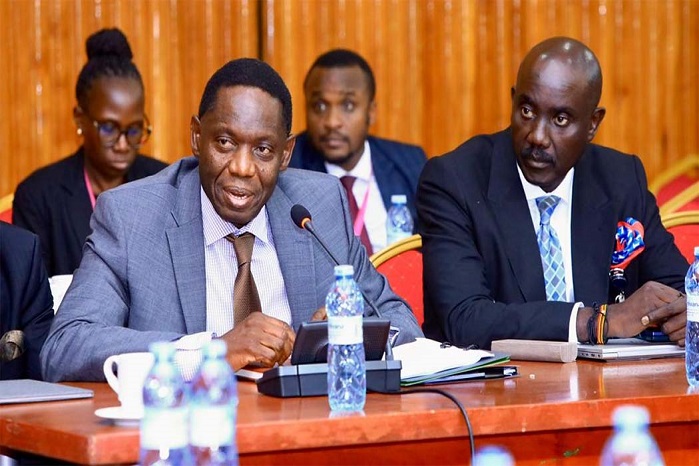
Bank of Uganda Officials, including Michael Atingi-Ego (left) and executive director of bank supervision Dr Tumubweine Twinemanzi at Parliament on 27th April 2026
HABARI DAILY I Kampala, Uganda I The proposed Protection of Sovereignty Bill, 2026 is facing mounting resistance from financial authorities, religious leaders and policy experts, who warn that its current provisions could inflict significant damage on Uganda’s economy and undermine its growth trajectory.
Appearing before a joint sitting of parliamentary committees, Michael Atingi-Ego delivered one of the strongest critiques yet, cautioning that the Bill risks introducing what he described as “voluntary shocks” to the country’s financial system.
At the centre of concern is a proposed cap on foreign funding set at Shs400 million annually, a threshold he argued is far below the scale at which Uganda’s financial sector operates.
According to the governor, the banking system requires significantly higher capital thresholds, with Tier I banks operating at Shs150 billion, Tier III at Shs10 billion and Tier IV institutions ranging between Shs500 million and Shs1.5 billion. Imposing such a low cap, he warned, would severely constrain capital mobilisation, limit liquidity flows and ultimately stifle investment.
“The cap is incompatible with the operational realities of our financial system,” Atingi-Ego told lawmakers, underscoring fears that legitimate financial activity could be choked off at a time when Uganda is seeking to attract more investment.
The broader economic implications are equally concerning. Uganda’s recent balance of payments performance has been supported by strong foreign inflows, including foreign direct investment and portfolio investments running into billions of dollars. Restricting cross-border financial flows, experts warn, could disrupt these inflows and place pressure on the Uganda shilling, potentially triggering currency instability and inflationary pressures.
One of the most contentious provisions is the classification of Ugandans living abroad as “foreigners.” This, analysts argue, could jeopardise remittance inflows, which currently contribute about $1.5 billion annually to the economy. These funds play a crucial role in supporting household consumption, education and small-scale enterprises.
By discouraging diaspora engagement, the Bill could inadvertently weaken one of the country’s most stable sources of foreign exchange. Additional inflows from non-governmental organisations—estimated at over $420 million annually—could also be disrupted, further tightening financial conditions.
Concerns have also been raised about the potential for capital flight. Offshore investors currently hold a notable share of government securities, and any new restrictions or approval requirements could prompt them to withdraw. Such a move would likely push interest rates higher, increasing the cost of borrowing for government at a time when debt servicing already consumes a significant portion of domestic revenue.
The digital economy, one of Uganda’s fastest-growing sectors, also stands to be affected. With millions of mobile money accounts processing tens of millions of transactions daily, the introduction of manual approval systems for financial flows could disrupt real-time transactions. Analysts warn that such inefficiencies could undermine confidence in the financial system and slow the momentum of digital innovation.
Beyond macroeconomic risks, the Bill could have direct consequences for employment. Estimates suggest that up to Shs5 trillion in external funding could be disrupted, putting between 20,000 and 50,000 jobs at risk, particularly in sectors reliant on international partnerships and donor support.
Religious leaders have also voiced strong opposition. Inter-Religious Council of Uganda, represented by Joseph Serwadda, warned that the Bill could shrink civic space, undermine religious freedom and threaten the survival of faith-based organisations.
“A strong law does not restrict broadly; it distinguishes carefully,” Serwadda told lawmakers, cautioning that sweeping provisions could weaken the very institutions that support communities and deliver essential services.
Diaspora representatives echoed similar concerns. Gloria Nalule McLaughlin, speaking on behalf of the Uganda Global Forum, called for targeted amendments, particularly the removal of provisions that classify Ugandans abroad as foreigners.
“We cannot be defined as foreigners elsewhere and also at home. Are we stateless?” she asked, highlighting the identity and economic implications of the proposal.
Political voices have also weighed in. Alice Alaso warned that concentrating oversight powers within a single ministry could reduce transparency and accountability while discouraging Ugandans from seeking opportunities abroad.
Taken together, the concerns paint a picture of a Bill that, while intended to safeguard national sovereignty, could inadvertently undermine economic stability, investor confidence and job creation. Experts argue that poorly calibrated restrictions on financial flows, combined with regulatory uncertainty, risk isolating Uganda from global financial systems at a time when integration is critical for growth.
As Parliament continues to scrutinise the proposed law, the debate underscores a delicate balancing act: protecting national interests without compromising the economic openness and institutional flexibility that have underpinned Uganda’s recent progress.