
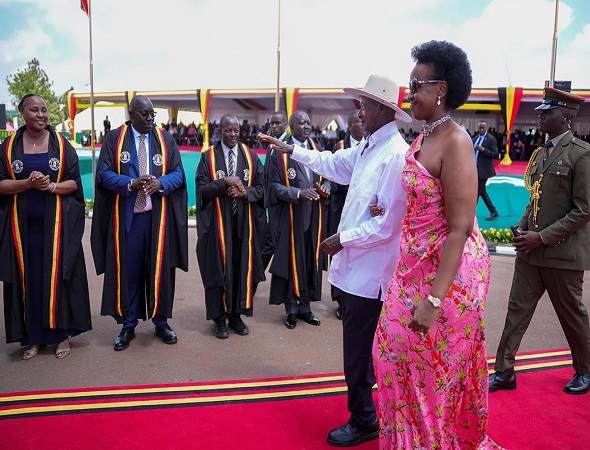
President Museveni waves at the members of the Electoral Commission headed by Justice Simon Byabakama after swearing in today on 12th May 2026
HABARI DAILY I Kampala, Uganda I President Yoweri Museveni has reiterated that Uganda has the potential to create 105 million jobs through small-scale commercial agriculture if citizens fully embrace the government’s four-acre model and wealth creation programmes.
Speaking during his inauguration ceremony for a seventh term at Kololo Independence Grounds in Kampala, Museveni said Uganda’s vast arable land and favourable climate provide enormous opportunities for employment and household income generation.
The President explained that Uganda has about 40 million acres of good arable land and argued that even if only seven million acres were properly utilised under small-scale commercial farming, the country could generate jobs far exceeding its current population.
He said the jobs would come from implementation of the four-acre model and seven key agricultural activities promoted by the National Resistance Movement (NRM) government.
“He said that the country has got 40 million acres of good arable land and if only 7 million acres were used the way Nyakana utilised his part, the country would have 105 million jobs in small scale commercial agriculture of the 4-acres model or less and the seven economic activities, alone,” Museveni noted.
“More jobs than the whole population of Uganda. This is before you talk of the big scale commercial agriculture such as Madhvani which employs 14,000 people at Kakira, before you talk of the manufacturing sector that employs 1.5 million people,” he added.
Museveni emphasized that the NRM’s central message remains wealth and job creation through strategic investment in key sectors of the economy.
“The message of the NRM is of two words, wealth and job creation. The four sectors; commercial agriculture, manufacturing, services and ICT for now have both low and high-skill jobs like in Kiira Motors and Karuma hydropower station. So don’t say you Museveni, you are talking about only low-skill jobs,” he said.
The President urged the remaining 33 percent of Ugandan households still outside the money economy to actively join productive economic activities in agriculture, industry, services and information communication technology.
According to Museveni, Uganda’s economic transformation can only be sustained if more citizens participate directly in wealth creation and commercial production.
To illustrate the impact of small-scale farming, Museveni cited success stories of Ugandans who adopted government advice on intensive agriculture and became wealthy entrepreneurs.
He highlighted the example of Johnson Basangwa from Kamuli District, who started poultry farming on a small residential plot.
“Johnson Basangwa of Kamuli listened to my advice. He had a plot of 50×100 ft which he used to start rearing chicken for eggs. He is now a rich man earning more than Shs7 billion a year now but not only is he a rich businessman now, he also employs 300 people,” Museveni said.
The President also pointed to the achievements of Richard Nyakana of Rwengaju in Kabarole District, whom he described as a model of successful small-scale commercial farming.
“There’s also Richard Nyakana of Rwengaju, Kabarole who has 1.3 acres of land. He invested in zero grazing for dairy cows, poultry, feeds and manure production. He earns a net of more than Shs240 million a year and employs 15 people,” he stated.
Beyond agriculture, Museveni stressed the need for Uganda to prioritize value addition and industrialization instead of exporting raw materials in unprocessed form.
He warned that exporting raw commodities deprives the country of jobs, industrial growth and higher earnings.
“Exporting raw materials is a strategic blunder. Let us take gold as an example. If you export a kilogram of unprocessed gold, 84 percent pure, recently you have been getting USD 60,000, if the gold is processed to 99.9 percent purity, you get USD168,000. Look at the difference in value,” Museveni explained.
“However, you don’t only donate the money to the outsiders per kilogram of gold or coffee, you also donate jobs like refining. That is not all, at 84 percent purity, that gold cannot be used as bullion, as currency or as an input in other industries such as jewellery, electronics etc. That’s one of the reasons African economies have remained stunted 70 years after the African countries started regaining their freedom,” he added.
Museveni said Uganda’s policy banning the export of unprocessed minerals is intended to encourage local processing industries, create employment opportunities and expand national revenues.
The President further argued that Africa remains economically underutilized despite its large population, abundant land and natural resources, calling for stronger regional integration and increased intra-African trade.
On education, Museveni called for reforms that equip learners with practical and employable skills capable of driving economic transformation.
He cautioned against academic programmes that do not directly contribute to productivity, innovation and job creation.
The President also warned against environmental degradation, particularly the destruction of wetlands and forests.
He said wetlands are essential for irrigation, rainfall formation and environmental sustainability, while forests protect water catchment areas and preserve indigenous medicinal resources.
Museveni revealed that government, under the Fourth National Development Plan (NDP-IV), would continue prioritizing agriculture, manufacturing, ICT and services as key drivers of socio-economic transformation.
He also urged citizens to monitor government programmes and actively participate in the management of Parish Development Model SACCOs to prevent misuse of public funds.
Vice President Jessica Alupo congratulated Museveni on his victory and inauguration, saying his electoral performance reflected widespread public support.
“Your Excellency’s score of 71.65 percent in the 2026 Presidential elections is evidence of the massive support that you and the NRM enjoy in the country,” Alupo said.
The inauguration ceremony was attended by several African leaders, including Presidents Hassan Sheikh Mohamud, Samia Suluhu Hassan, Daniel Francisco Chapo, Salva Kiir Mayardit and Évariste Ndayishimiye, among other dignitaries.
Guests were also entertained by military displays from the Uganda People’s Defence Forces, including performances by the Land Forces, Air Forces, Special Forces Command and Reserve Forces.