
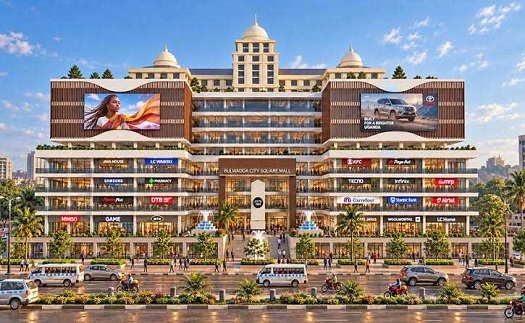
Graphic representation of the redeveloped Constitutional Square in Kampala
HABARI DAILY I Kampala, Uganda I The Uganda Government has backtracked on its proposal to redevelop Constitutional Square in Kampala following concerns over the site’s historical significance, legal protection, environmental implications and urban planning considerations, with Cabinet resolving to preserve the public space in its existing status.
In a statement delivered during the weekly Cabinet press briefing on October 26, 2026, Justine Kasule Lumumba, the Minister for ICT and National Guidance, said Cabinet had decided to reverse the proposed development of City Square, formally known as Constitutional Square.
“Cabinet has decided to reverse the proposal for the development of City Square, formally known as Constitutional Square, and retain the site’s existing legal status,” Lumumba said.
She explained that the decision followed a review of the site’s history, the laws protecting it, and environmental and urban planning issues raised by the redevelopment proposal.
“This decision followed consideration of the site’s history, its legal protection, and the environmental and urban planning issues raised by the proposal,” she added.
The announcement marks a retreat from the proposed redevelopment and signals the Government’s decision to prioritise the preservation of the square over the planned changes to the site.
Heritage protection at the centre of the decision
One of the key reasons for abandoning the redevelopment plan is the square’s protected heritage status, which places restrictions on how the site can be altered or developed.
According to Lumumba, Constitutional Square has been protected since 2007, with its status recognised under the Museums and Monuments Act, 2023, and a heritage protection instrument issued in 2024.
The protected area covers approximately 1.172 hectares, comprising plots 5, 6 and 7.
The square also contains the 1945 War Memorial, a monument commemorating Ugandan soldiers who lost their lives during the First and Second World Wars.
For the Government, the presence of the memorial and the square’s protected status meant that any decision about redevelopment had to take into account the historical value of the location.
“The Square and its memorial are part of our national history. Decisions about the site must respect that history and its protected status,” Lumumba said.
The explanation suggests that the decision was not merely about the physical transformation of a public space but also about the responsibility to safeguard a nationally significant historical landmark.
Legal status takes precedence over redevelopment
The Government’s decision also places emphasis on compliance with the legal framework governing the square.
By retaining its existing legal status, Cabinet has effectively abandoned the proposal in favour of maintaining the protections already attached to the site.
The Museums and Monuments Act, 2023, together with the 2024 heritage protection instrument cited by Lumumba, provides the legal context for the Government’s position.
The square’s protection, which dates back to 2007, further underscores that its heritage status predates the latest redevelopment proposal.
The minister did not disclose whether the Government had considered alternative designs or locations for the proposed development, nor did she provide details of the financial implications of reversing the plan.
However, her statement left no ambiguity about Cabinet’s position on the immediate future of the site.
“The public should therefore be clear: Cabinet has reversed the development proposal. Constitutional Square will retain its existing legal status,” Lumumba said.
Environmental and urban planning concerns
Environmental and urban planning issues were also among the considerations that informed Cabinet’s decision.
Although Lumumba did not elaborate on the specific environmental concerns raised or identify the particular planning objections considered, she confirmed that these issues formed part of the assessment leading to the reversal.
The decision highlights the competing considerations that can arise when authorities seek to change the use or appearance of public spaces in a growing capital city.
Constitutional Square occupies a prominent position in central Kampala and carries both historical and civic significance. Its future therefore involves questions beyond redevelopment, including heritage conservation, the management of public spaces and the preservation of landmarks that connect present-day Uganda with its past.
The Cabinet statement, however, did not provide a detailed account of the technical assessments, consultations or recommendations that preceded the decision.
Public pressure and political opposition
Cabinet’s reversal follows weeks of public debate and opposition from political leaders, urban planners and other Ugandans who argued that the proposed commercial complex threatened one of Kampala’s remaining public green spaces.
President Yoweri Museveni had, on August 30, 2026, directed the Minister for Kampala Capital City and Metropolitan Affairs, Minsa Kabanda, to assess a proposal by businessman Hassan Bulwadda to transform approximately two acres of City Square into a modern commercial complex featuring a hotel and shopping mall. The proposal envisaged solar power and other environmentally friendly features.
However, the plan attracted criticism from Kampala Lord Mayor Ronald Balimwezo, who argued that the square should remain an open public space serving environmental, recreational and emergency-response purposes.
In September, Balimwezo petitioned the Attorney General to advise the Government against the redevelopment, warning that the site was important for managing stormwater, filtering dust and providing greenery in the city centre.
“With Kampala’s temperature rising and flooding increasing around that area, concreting this space will worsen the climate crisis in the city centre,” Balimwezo said, according to Daily Monitor. He also described the square as a free recreation space for city workers and students.
The Lord Mayor maintained that the site should be protected permanently and called on authorities to consider alternative locations for commercial investment rather than sacrificing existing public spaces.
The Leader of the Opposition in Parliament, Joel Ssenyonyi, also questioned the proposal, raising concerns about Parliament’s exclusion from discussions over the future of the square.
During a parliamentary sitting on September 30, Ssenyonyi warned against losing one of the capital’s remaining green spaces and argued that government should instead seek opportunities to create more public recreational areas.
The controversy also drew criticism from urban planning experts. Dr Amin Tamale, head of urban and regional planning at Makerere University’s College of Engineering, Design, Art and Technology, argued that Kampala needed balanced and inclusive development rather than the loss of important public spaces.
A landmark preserved for future generations
The debate also attracted cultural and political voices who questioned whether commercial development was the most appropriate use of the historic site.
The Federation of Uganda’s opposition Forum for Democratic Change (FDC) criticised the proposal, with party official Franco describing Constitutional Square as a gazetted national cultural monument and historical site.
“Kampala does not need another private mall; it needs public breathing space,” Franco said, warning that commercialisation could worsen flooding and congestion.
These objections reflected wider concerns about the management of public land, the preservation of Kampala’s historical identity and the need to balance private investment with the interests of city residents.







About the Author