Justine Kasule Lumumba
HABARI DAILY I Kampala, Uganda I The Uganda Government has approved the allocation of an additional six acres of public land to the United Nations Regional Service Centre in Entebbe, in a move aimed at accommodating the expanding operations of the international organisation, strengthening Uganda’s position as a host of international services and generating greater economic activity for local businesses.
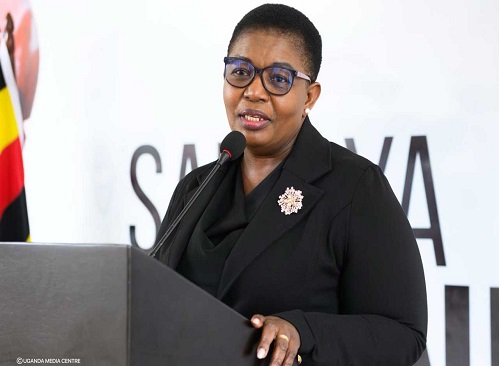
Justine Kasule Lumumba, the Minister for ICT and National Guidance, announced the Cabinet decision during the weekly Cabinet press briefing at the Uganda Media Centre on Monday, October 26, 2026, explaining that the additional land would enable the centre to take on more responsibilities as the United Nations reorganises its operations.
“Cabinet has approved the reallocation of an additional six acres of Government land to the United Nations Regional Service Centre in Entebbe. The land will come from the Ministry of Agriculture, Animal Industry and Fisheries,” Lumumba said.
The decision increases the land available to the centre, which currently occupies 20 acres that have been fully utilised, leaving limited room for the expansion of its operations.
“The Centre has fully used the 20 acres it currently occupies. The additional land will give it room to expand as it takes on more responsibilities,” she explained.
The allocation is therefore intended to address an immediate infrastructure challenge facing the centre while supporting Uganda’s broader ambition to attract and host more international operations.
Accommodating expanding UN operations
Established in 2010, the United Nations Regional Service Centre in Entebbe provides finance, human resources, administrative, logistics and information and communications technology support to United Nations operations.
These services enable UN missions to concentrate on their mandates while relying on the centre for essential administrative and operational support.
However, the United Nations is reorganising its operations to reduce costs and make better use of its resources. Uganda has offered to host more of these services in Entebbe, creating the need for additional space.
Lumumba said President Yoweri Kaguta Museveni conveyed Uganda’s offer to the UN Secretary-General in June 2025, and the Secretary-General welcomed it in his response dated July 15, 2026.
The centre has already taken over a range of administrative and support functions previously handled by the Kuwait Joint Support Office, with the transfer taking effect on July 1, 2026.
The additional land is intended to accommodate this growing workload and provide room for further expansion as more functions are transferred to Entebbe.
The Government’s decision consequently reflects a strategic partnership in which Uganda provides the space and hosting environment while the United Nations consolidates its support services in the country.
Economic benefits for Ugandans
Beyond providing land for the international organisation, the Government expects the expansion to generate economic opportunities for Ugandan businesses supplying goods and services to the centre and its employees.
Lumumba said figures presented to Cabinet indicated that staff spending injects approximately US$40 million into the local economy annually, while local contracts contribute a further US$33 million.
“The figures presented to Cabinet indicate that staff spending brings about US$40 million into the local economy each year, while local contracts account for a further US$33 million,” she said.
The spending supports businesses that supply goods and services to the centre and its staff, creating commercial opportunities for enterprises operating in Entebbe and the surrounding areas.
These businesses may benefit from demand for accommodation, transport, food, supplies, professional services and other requirements associated with the operations of an international institution.
The Government believes that creating room for the centre to expand will help sustain and potentially increase this economic activity.
For Uganda, the six-acre allocation is therefore being presented not simply as the provision of public land to a foreign institution, but as an investment in an arrangement expected to generate business for local suppliers and service providers.
Entebbe to become a major UN travel hub
Another factor behind the decision is the anticipated growth in travel-related operations at the centre.
According to Lumumba, the Entebbe facility is expected to become the largest travel ticketing office in the United Nations system, handling an average of approximately 250 tickets daily.
Such an operation is expected to support additional activity in travel management and related services, further reinforcing Entebbe’s role as a regional centre for international operations.
The anticipated growth in travel services also illustrates the wider responsibilities the facility is expected to assume as the UN consolidates its support functions.
The additional land is expected to provide the physical space required to accommodate the centre’s expanding activities.
Uganda’s international standing
The Government also sees the allocation as an opportunity to strengthen Uganda’s position as a host of international services and deepen its partnership with the United Nations.
By accommodating more UN operations, Uganda hopes to establish Entebbe as an increasingly important location for international administrative and logistical services.
Lumumba said the Government’s decision was intended to support the country’s partnership with the organisation while creating room for greater economic activity.
“By providing room for expansion, Government is supporting Uganda’s partnership with the United Nations and creating space for greater economic activity in Entebbe,” she said.







About the Author