
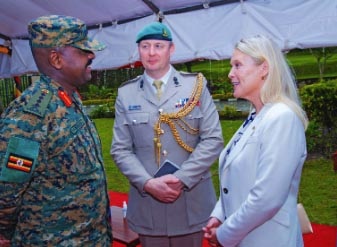
Gen Muhoozi Kainerugaba (L) with the UK High Commissioner to Uganda Lisa Chesney (R) in Fort Portal recently
HABARI DAILY I Kampala, Uganda I Uganda is to solidify its partnership with Uganda’s longstanding defence partner, the United Kingdom, following renewed engagements between the Uganda People’s Defence Forces (UPDF) leadership and British officials, with support for military schools and training programmes emerging as an area of co-operation.
The engagement is expected to strengthen professional development, technical training and capacity building within the UPDF, alongside broader collaboration in counter-terrorism and regional security.
The Chief of Defence Forces (CDF), Gen Muhoozi Kainerugaba, met British High Commissioner to Uganda Lisa Chesney in Fort Portal, where the two sides discussed ways of deepening bilateral defence relations.
The meeting was also attended by Lt Col Ash Wiseman, the British Defence Attaché to Uganda, and focused on areas where the two countries could expand co-operation to strengthen military capabilities.
The discussions come amid continued efforts by Kampala and London to maintain defence ties through high-level engagements, professional exchanges and military training initiatives.
Support for UPDF schools would be significant in strengthening the training of military personnel, improving professional standards and equipping officers with skills needed to respond to evolving security challenges.
However, details of the proposed support, including the institutions to benefit, funding commitments and implementation timelines, were not provided in the information available on the meeting.
Training and capacity building at the centre
The two delegations discussed professional development, technical training and capacity building across various military disciplines, reflecting a shared interest in strengthening the competence and preparedness of their respective defence personnel.
Military schools play an important role in preparing officers and other personnel for leadership, operational duties and specialised assignments. Support through training partnerships, technical expertise and professional exchanges can help strengthen institutional capacity.
For the UPDF, such co-operation could complement ongoing efforts to improve military education and prepare personnel for domestic and regional security responsibilities.
The talks also covered enhanced military training programmes, although the specific courses or training institutions involved were not disclosed.
Uganda and the UK reaffirmed their commitment to maintaining regular engagements to advance their areas of mutual interest.
The discussions are part of a wider framework of defence co-operation in which military training, professional exchanges and capacity building provide opportunities for the two countries to share expertise and strengthen their institutional relationships.
Regional security and counter-terrorism
Beyond military education, the meeting addressed regional security and counter-terrorism, areas that remain important to Uganda’s defence and foreign policy interests.
Uganda has participated in regional security initiatives and military operations, making the professional preparation of its personnel a key consideration in maintaining operational readiness.
Co-operation with Britain in technical training and capacity building could support efforts to improve the skills required to address emerging security threats.
The discussions also provide an avenue for the two countries to exchange experience and maintain communication on regional developments.
Neither side disclosed specific new operational commitments arising from the Fort Portal meeting. The engagement was instead presented as part of continuing bilateral discussions aimed at sustaining and expanding existing areas of co-operation.
Renewed engagement after UK visit
The meeting builds on sustained contacts between the UPDF leadership and British officials and follows Gen Kainerugaba’s visit to the United Kingdom, where he held high-level bilateral engagements.
The latest discussions in Fort Portal underscore the importance both countries attach to maintaining direct communication between their defence institutions.
For Britain, continued engagement provides an avenue for co-operation with Uganda on shared security concerns, professional military development and regional stability. For Uganda, such partnerships offer opportunities to strengthen training and technical capacity while maintaining relationships with international defence partners.
The participation of the British High Commissioner and the Defence Attaché also reflects the diplomatic and military dimensions of the relationship.
Both sides indicated their intention to sustain regular engagements, suggesting that the discussions could provide a basis for further consultations on training programmes and other areas of defence co-operation.
Partnership anchored in shared interests
Uganda and the UK have continued to engage on matters of mutual interest, with defence co-operation forming part of their broader bilateral relationship.
The latest meeting signals an intention to deepen those ties through professional development, technical training, capacity building and enhanced military education.
Although the precise scope of British support for UPDF schools remains to be clarified, the discussions highlight the potential importance of training partnerships in strengthening military institutions.
The proposed co-operation also comes at a time when defence forces face increasingly complex security demands that require specialised skills, professional standards and continuous training.
As Kampala and London continue their engagements, the implementation of concrete training initiatives and clarification of the support available to UPDF schools will determine the practical impact of the renewed partnership.
For now, both sides have reaffirmed their commitment to regular dialogue, with military training and regional security remaining central to efforts to strengthen relations between Uganda and the United Kingdom.







About the Author