

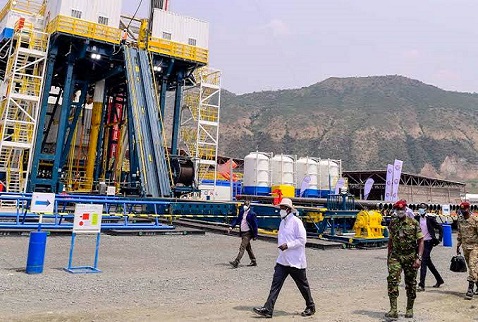
Museveni inspects the oil facility in Kikuube district after unveiling the name today, 2nd September 2026
HABARI DAILY I Kampala, Uganda I Uganda has named its upcoming crude oil blend Pearl Sweet, giving the country’s petroleum a distinct commercial identity as it prepares to enter the international oil market and begin production in 2026.
President Yoweri Museveni unveiled the name during a ceremony at the Kingfisher Development Area in Kikuube District, marking another milestone in Uganda’s journey towards becoming an oil-producing and exporting country.
The name is more than a patriotic branding exercise. It combines Uganda’s national identity with one of the most commercially important characteristics of its crude—the relatively low sulphur content.
Why ‘Pearl’?
The first part of the name, Pearl, draws directly from Uganda’s long-standing description as the “Pearl of Africa.”
The phrase was popularised by British statesman Winston Churchill after his travels through Uganda, and has since become one of the country’s best-known international identities.
By attaching “Pearl” to its crude oil, Uganda is effectively carrying that national identity into the global petroleum market.
The decision also gives Ugandan crude a recognisable name that international traders, refiners and other industry players can associate with oil produced in the country.
This is important because crude oil is not simply traded as a generic commodity. Different grades are identified and priced according to their characteristics, including density, sulphur content, location and suitability for particular refineries.
Well-known grades such as Brent, West Texas Intermediate, Nigeria’s Bonny Light and South Sudan’s Dar Blend have established identities in international markets.
Pearl Sweet will similarly become the name used to identify Uganda’s combined crude production from the CNOOC-operated Kingfisher field and TotalEnergies-operated Tilenga development before it is exported.
Why ‘Sweet’?
The second word has nothing to do with taste or human consumption. According to Uganda National Oil Company spokesperson Tony Otoa, “sweet” is an established petroleum industry term referring to crude oil with low sulphur content, typically below 0.5 percent.
Uganda’s crude contains approximately 0.16 percent sulphur, giving it a significant quality characteristic that the government believes can make the oil commercially attractive.
Historically, the terminology is linked to an old practice among oil prospectors who tasted crude to assess its characteristics. Low-sulphur crude was said to have a mildly sweet taste, while oil containing higher levels of sulphur had an unpleasant taste and became known as “sour” crude.
Today, however, the term is strictly a technical description.
Low-sulphur crude is generally easier and cheaper for refineries to process because less sulphur needs to be removed. Desulphurisation requires additional equipment and processing, which increases refining costs.
“Sweet crude is more desirable because it’s cheaper and easier to refine into gasoline and diesel, since you don’t have to strip out as much sulphur,” Otoa said.
The low sulphur content could therefore help Pearl Sweet attract buyers, although its ultimate market price will depend on several other factors, including its density, transportation costs, supply reliability and individual refinery requirements.
Uganda’s distinctive crude
Pearl Sweet will nevertheless have characteristics that distinguish it from other international grades.
Uganda’s crude ranges between approximately 23 and 33 degrees API gravity and is described as paraffinic and waxy. Its high pour point means that the crude can thicken at ordinary temperatures.
This characteristic has influenced the design of Uganda’s export infrastructure.
The 1,443-kilometre East African Crude Oil Pipeline (EACOP) from Uganda to Tanzania’s Indian Ocean port of Tanga will require electrical heating to keep the crude flowing through the pipeline.
The oil will therefore travel from Uganda’s oil fields through EACOP before reaching international markets through the port of Tanga.
Production and economic expectations
The naming of Pearl Sweet comes as Uganda moves closer to commercial production after years of exploration, development and investment.
Kingfisher is expected to reach peak production of about 40,000 barrels per day, while Tilenga is projected to produce approximately 190,000 barrels per day.
Uganda estimates its petroleum resources at about 6.5 billion barrels initially in place, although only a portion is currently considered recoverable.
The oil industry has already attracted billions of dollars in investment, with approximately $7 billion invested in Uganda’s oil and gas sector.
For the government, however, the ultimate significance of Pearl Sweet goes beyond the revenue generated from selling crude.
President Museveni’s administration has repeatedly argued that oil revenues should be invested in productive sectors and long-term economic infrastructure rather than consumed in the short term.
The government hopes petroleum income can help finance infrastructure and other investments capable of supporting Uganda’s economy long after the country’s oil reserves decline.
A brand entering a global market
The unveiling of Pearl Sweet therefore represents both a symbolic and commercial step.
Uganda is no longer preparing merely to produce crude oil; it is preparing to market a specific crude grade to international buyers.
Once commercial cargoes begin reaching refiners, Pearl Sweet’s reputation will ultimately depend on the quality of the crude, consistency of supply, transportation costs and how effectively it meets refinery requirements.
For Uganda, the choice of name seeks to communicate two things at once: where the oil comes from and why its quality matters.
“Pearl” connects the crude to Uganda’s national identity, while “Sweet” highlights its low sulphur content.
Together, the two words provide Uganda with a marketable identity as the country takes its first steps into the global petroleum trade.