
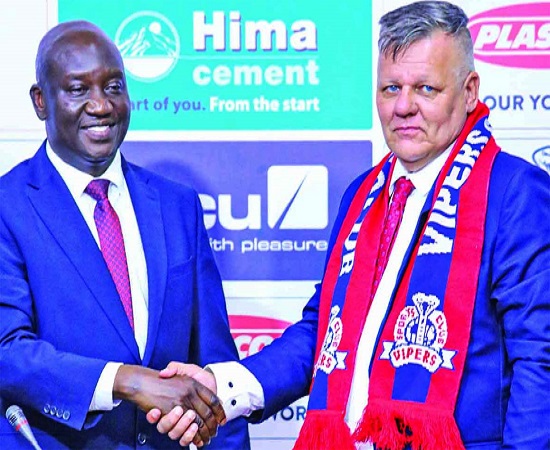
Vipers SC and head coach Ivan Minnaert (Right) and Club President, Lawrence Mulindwa
HABARI DAILY I Kampala, Uganda I This eventual separation was long in waiting as signs had increasingly emerged that Vipers SC and head coach Ivan Minnaert were heading in different directions despite a successful domestic campaign that culminated in the club winning the 2025/26 Uganda Premier League title.
The Belgian tactician officially left the Kitende-based side following the expiration of his contract at the end of the season, with the club opting against offering him a new deal. While Vipers SC publicly attributed the departure to the natural conclusion of his contract, several developments throughout the season had already hinted that his future at the club was uncertain.
At the heart of the growing doubts was Vipers’ performance on the continental stage. Club officials had entrusted Minnaert with the responsibility of not only reclaiming domestic supremacy but also making a significant impact in the CAF Champions League.
However, that ambition suffered an early setback when Vipers were eliminated by Zambia’s Power Dynamos in the final preliminary round of the competition. The exit was a major disappointment for a club that has invested heavily in recent years with the goal of establishing itself among Africa’s elite sides.
The continental failure proved particularly damaging because it denied Vipers a place in the lucrative group stages, which had been viewed as one of the season’s key targets. Although the team would later dominate the local league, many observers believed the Champions League disappointment had already weakened Minnaert’s position.
Questions regarding the team’s style of play also persisted throughout the season. Despite delivering results, Minnaert’s tactical approach was not universally embraced by supporters or sections of the club’s hierarchy.
Critics argued that his system prioritized discipline, defensive organization and structure at the expense of creativity and attacking flair. Some fans frequently complained that the team lacked the entertaining brand of football traditionally associated with a club possessing some of the country’s most talented players.
Reports also indicated concerns over the deployment of certain footballers in unfamiliar positions, a tactical choice that occasionally sparked debate among supporters and football analysts.
Further signs of growing dissatisfaction emerged during the closing stages of the campaign. Vipers experienced a series of draws that raised concerns about consistency and momentum heading into the season’s decisive period.
The club also failed to secure a domestic double after being knocked out of the Stanbic Uganda Cup by Kitara FC. While winning the league title remained a significant achievement, the cup elimination denied Minnaert an opportunity to strengthen his case for a contract extension.
The pressure was further amplified by the culture of high expectations that exists at Vipers SC under club president Dr. Lawrence Mulindwa. Over the years, the club has established a reputation for demanding excellence both domestically and internationally.
At Vipers, winning the league is often regarded as the minimum requirement rather than the ultimate objective. The club’s leadership has consistently emphasized continental success and attractive football as critical measures of progress.
As a result, Minnaert’s achievements, including securing the league crown and earning recognition as Coach of the Season, were ultimately not enough to guarantee his continued stay at Kitende.
By the time the season concluded, the combination of continental disappointment, concerns about playing style, the Uganda Cup exit and the club’s relentless pursuit of higher standards had already created the impression that a separation was increasingly inevitable.
The official announcement may have cited the expiration of his contract, but the warning signs that Vipers SC was preparing for a new direction had been visible for months.







About the Author