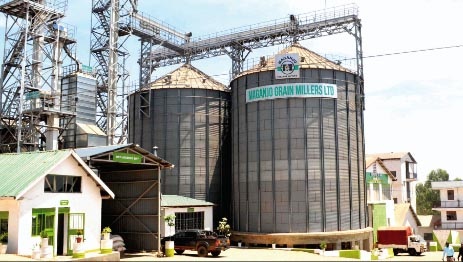
Maganjo Grain Millers’ mill, located at Maganjo, 7km along the Kampala-Gulu highway
HABARI DAILY I Kampala, Uganda I Entrepreneurship has proved to be a relentless journey, demanding resilience, innovation and an unwavering commitment to turning challenges into opportunities.
For Dr Benon Luggya, the founder of Maganjo Grain Millers Limited, the journey began in 1979 with just two kilogrammes of groundnuts, five kilogrammes of soya beans, limited capital and no electricity or sophisticated machinery.
What started as a modest venture in roasting groundnuts and processing soya beans has grown into one of Uganda’s leading grain-processing enterprises and one of the major human food milling businesses in East Africa. Today, Maganjo Grain Millers operates production facilities in Maganjo and Jinja, maintains more than 30 distribution outlets across Uganda, exports products to more than 40 countries and employs over 3,000 permanent and casual workers.
Luggya estimates the value of the enterprise at more than Sh200b, a remarkable transformation for a business that emerged from the determination of a former primary school teacher seeking to improve his family’s livelihood.
His entrepreneurial journey demonstrates how small businesses can grow into major industrial enterprises through calculated risks, persistence, diversification and investment in production, distribution and people.
From the classroom to entrepreneurship
Born in 1953 in Gomba District, Luggya began his working life as a primary school teacher. Although teaching provided him with an income, he eventually realised that his earnings could not adequately meet his family’s financial needs after he got married.

Dr Benon Luggya
“Before venturing into a milling business, I was a primary school teacher, but after getting married, I realised that what I was earning was not enough and decided to venture into business,” he says.
In 1979, he began processing small quantities of groundnuts and soya beans, working with minimal resources and without electricity. Much of the work was manual, restricting production and making it difficult to meet growing demand or accumulate sufficient capital for expansion.
However, Luggya looked beyond the modest trade he had established. His ambition was to build a milling factory capable of processing agricultural produce on a commercial scale.
Achieving that goal required him to take significant financial risks. He sold his retail shop to raise money for the milling equipment he needed, hoping the investment would enable him to establish a more productive operation.
The plan, however, encountered an unexpected setback when the contractor expected to supply the machinery failed to deliver suitable equipment. The machinery installed could not function as required, threatening to derail the project before it had properly begun.
Rather than abandon his ambitions, Luggya searched for an alternative solution. He turned to local fabrication, improvising machinery that could enable him to begin milling operations. In one of his early innovations, he used a car engine to power the milling equipment.
This experience demonstrated a defining characteristic of his entrepreneurial approach: adapting available resources to overcome obstacles rather than allowing limited access to technology to stop the business from progressing.
The improvised machinery helped him move towards his goal of establishing a milling enterprise, laying the foundation for the industrial business that Maganjo Grain Millers would eventually become.
Diversification opens new markets
In its early years, Maganjo Grain Millers depended heavily on a single product, maize flour. Although the product provided a foundation for the business, reliance on one line limited its opportunities for growth and exposed it to fluctuations in demand and market conditions.
Luggya recognised that sustainable expansion would require the company to serve different consumer groups and develop a wider product portfolio.
“While Maganjo initially survived entirely on a single brand of maize flour, we diversified production to capture different market segments. Over the decades, the company scaled to produce more products using raw materials such as millet flour, maize, soya beans, wheat and silverfish, among others, while adding value,” he says.
Diversification enabled the company to broaden its customer base and respond to changing consumer preferences. By processing different agricultural commodities, Maganjo moved beyond its original maize flour business into a wider range of grain-based and other food products.
The strategy also strengthened the company’s participation in Uganda’s agro-processing industry, where value addition creates opportunities to turn agricultural produce into finished goods with greater commercial value.
Rather than simply trading in unprocessed commodities, the company processes raw materials into products for domestic and international markets.
This shift from small-scale processing to diversified manufacturing has been central to its growth, helping the enterprise develop a stronger production base and reach more customers.
Linking farmers to industrial markets
Maganjo Grain Millers’ expansion has also created an important connection between agricultural producers and the food-processing industry.
The company purchases grains from farmers across Uganda, providing an industrial market for agricultural produce and linking smallholder farmers to a business that requires consistent supplies of raw materials.
For small-scale farmers, dependable markets can be crucial to improving household incomes and making agriculture more commercially viable. Reliable demand can encourage farmers to increase production, invest in better farming practices and plan their activities around market requirements.
Through its procurement operations, Maganjo contributes to a broader agricultural value chain involving farmers, traders, transporters, processors and distributors.
The company’s activities extend beyond purchasing produce. It manages more than 600 acres of farmland in Nakaseke and Nakasongola districts, while also undertaking tree-planting initiatives intended to promote environmental conservation.
These investments reflect the relationship between agricultural production, industrial processing and environmental sustainability. They also demonstrate how an agro-processing business can stimulate economic activity beyond its factory premises.
Building a national and international footprint
From its modest beginnings, Maganjo Grain Millers has expanded its production capacity through facilities in Maganjo and Jinja, supported by a distribution network of more than 30 outlets across Uganda.
The company has also developed an export market spanning more than 40 countries, including destinations in Europe.
This international reach represents a significant milestone for a business that began with a few kilogrammes of agricultural produce and rudimentary processing methods.
By developing production facilities alongside a distribution network, the company has strengthened its capacity to move products to consumers and serve markets beyond its immediate locality.
Luggya attributes the company’s development to innovation and a commitment to quality, which he says have been central to its ability to serve different markets.
Its growth has also created employment opportunities, with more than 3,000 permanent and casual workers engaged across its operations. The expansion illustrates the potential of locally established enterprises to contribute to employment, manufacturing and agricultural value addition.
Investing in education, community development
Beyond manufacturing, Luggya has extended his investments into education, establishing and sustaining four schools: Midland School Kawempe, Midland School Mukono-Buntaba, Mukono Light Academy and Midland Junior School.
The institutions employ more than 350 teaching and non-teaching staff and provide educational opportunities to children, including learners supported through scholarships and bursaries.
The education investments broaden the impact of his entrepreneurial journey by connecting business development with community advancement. The schools provide employment while helping families access educational opportunities for their children.
For Luggya, the growth of Maganjo Grain Millers therefore extends beyond the production of food products. It encompasses employment, agricultural markets, education and investment in the wider community.
Sharing lessons with aspiring entrepreneurs
Luggya is among the key speakers expected at the 2026 Global Entrepreneurship Week conferences scheduled for November 19–20 at Enterprise Uganda, opposite Butabika Hospital.
The Vision Group Pakasa Forum will climax the activities on November 21, 2026, at Enterprise Uganda under the theme “Opportunities and Ideas for Growing Businesses.”
His journey offers aspiring entrepreneurs an example of how a small enterprise can evolve through persistence, practical innovation, diversification and reinvestment.
Starting with limited capital and rudimentary equipment, Luggya confronted machinery failures, the constraints of manual production and the risks associated with dependence on a single product. He responded by improvising solutions, expanding his product range, investing in production capacity and building markets for his goods.
The resulting enterprise, which he values at more than Sh200b, demonstrates the scale of growth possible when entrepreneurial ambition is matched with sustained investment and adaptation.
Maganjo Grain Miller’s evolution illustrates how Uganda’s entrepreneurs can turn modest beginnings into substantial businesses capable of supporting farmers, creating jobs, adding value to agricultural produce and investing in the next generation.







About the Author