


HABARI DAILY I Kampala, Uganda I Chinese smartphone manufacturers are helping narrow Africa’s digital divide by making mobile internet financially accessible to millions of people and developing devices tailored to the continent’s infrastructure, economic realities and cultural needs.
Led by Transsion Holdings, the parent company of TECNO, Infinix and itel, alongside Xiaomi, OPPO and Honor, Chinese manufacturers have captured a substantial share of Africa’s smartphone market by offering affordable devices with features designed around everyday challenges faced by African consumers.
Their growing influence is transforming smartphones from expensive technological luxuries into essential tools for communication, education, financial transactions, agriculture, entertainment and business.
According to technology research firm Omdia, smartphone shipments in Africa reached 84.4 million units in 2025. Transsion ranked first, recording 40.5 million shipments and capturing 48 per cent of the market. Xiaomi, Honor and OPPO occupied the third, fourth and fifth positions, respectively.
The figures illustrate how Chinese manufacturers have reshaped the continent’s mobile technology landscape by prioritising affordability, practical functionality and local market requirements.
Breaking the Price Barrier
For years, the high cost of smartphones remained one of the biggest obstacles to digital inclusion across sub-Saharan Africa, where many households have limited disposable income and must prioritise essential expenses.
Although mobile connectivity offers opportunities for education, employment and entrepreneurship, access to these benefits depends partly on owning a compatible device. Expensive smartphones therefore excluded many potential internet users, particularly low-income households and rural communities.
Chinese manufacturers have challenged this barrier by expanding the availability of smartphones in the sub-$100 and sub-$200 categories, allowing consumers to access internet-enabled devices without paying the premium associated with many established international brands.
Their strategy has combined competitive pricing with features that users would otherwise have to sacrifice when purchasing cheaper handsets.
Manufacturing and assembly operations have also supported their expansion. Transsion, for example, operates a major smartphone manufacturing facility on the outskirts of Addis Ababa, Ethiopia, producing devices for the domestic market and neighbouring countries.
Local production and regional distribution can help reduce logistical expenses and improve access to devices, although the extent of savings depends on components, taxes and other operating costs.
By targeting price-sensitive consumers, Chinese manufacturers have expanded the pool of people able to participate in Africa’s growing digital economy.
Designing Phones for African Conditions
Affordability alone does not explain the popularity of Chinese smartphones. Their manufacturers have also invested in understanding the practical challenges African consumers encounter, from unreliable electricity supplies to inconsistent network coverage and expensive mobile data.
Battery performance is one example. In communities where electricity is unreliable, a phone that requires frequent charging can become a significant inconvenience.
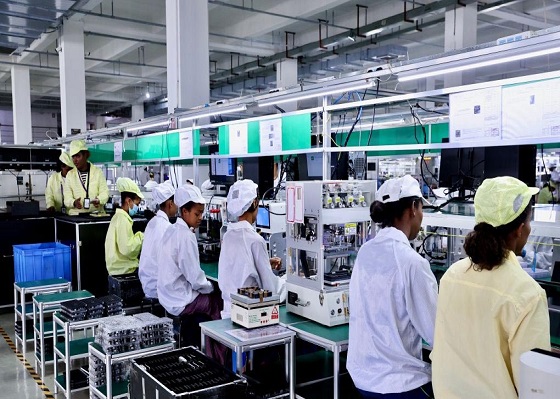
A mobile phone manufacturing line in Adis Ababa, Ethiopia
Many Chinese smartphone models therefore feature large-capacity batteries and power-management systems designed to extend usage between charges.
For Nigerian university student Femi Adesegun, who works part-time as a delivery rider, this feature has had direct economic benefits.
His previous phone frequently ran out of power by midday as he used it to receive orders, navigate routes, communicate with customers and process digital payments.
After switching to a Chinese smartphone with a larger battery, he said he no longer faced the same disruption.
The experience demonstrates how seemingly basic hardware improvements can help workers remain connected, complete transactions and earn an income.
Multi-SIM functionality has also proved valuable in markets where consumers switch between mobile networks to obtain better coverage or more affordable data packages. By supporting multiple SIM cards, manufacturers give users greater flexibility in managing connectivity costs.
These features are particularly important in countries where network quality and mobile service prices vary considerably between providers and locations.
Cameras and Software That Reflect Local Needs
Chinese manufacturers have also differentiated their products through software and camera technologies adapted to African consumers.
For years, some smartphone cameras struggled to reproduce darker skin tones accurately, reflecting limitations in image processing and the representation of different complexions in technology development.
Transsion has invested in camera research and development to improve exposure, lighting and image reproduction for darker-skinned users.
At its Nairobi office, staff test smartphone cameras using colour-calibration equipment and culturally distinctive objects, including Maasai carvings, patterned fabrics and masks.
Ma Xiaochuan, Transsion’s general manager for East Africa, said capturing a person’s true appearance was not merely a technical matter but also one of dignity.
The company’s approach illustrates how localisation can extend beyond price and hardware to address representation and user experience.
Software adaptations, including keyboards supporting local languages such as Amharic, can similarly make digital services easier to use for people who are more comfortable communicating in their native languages.
Such adjustments help reduce barriers for first-time smartphone users and communities that have historically been underserved by mainstream technology.
Smartphones Fuel Africa’s Digital Economy
The growing availability of affordable smartphones has also supported the expansion of digital financial services, online commerce and entertainment across the continent.
Mobile devices increasingly provide access to digital wallets, banking applications, payment platforms and other services that allow users to transact without visiting physical branches or relying exclusively on cash.
Platforms such as PalmPay illustrate the expanding role of digital payments in everyday economic activity. Affordable smartphones help more consumers access these services, although mobile connectivity, electricity, digital literacy and access to financial accounts remain important conditions for participation.
Chinese technology companies have also contributed to local digital ecosystems. Transsion has helped build the market for Boomplay, a music-streaming platform focused on African audiences and musical content.
These developments create opportunities for artists, merchants, entrepreneurs and other service providers to reach customers through digital channels.
For small businesses, a smartphone can serve as a communications centre, bookkeeping tool, marketing platform and payment terminal, reducing the need to purchase several separate devices.
Empowering Farmers and Digital Creators
The impact extends beyond urban consumers and conventional office work.
Nigerian farmer Nzubechukwu Kanu uses his smartphone to manage farm finances, separate personal and business accounts and obtain AI-assisted crop-yield mapping.
He said the device’s signal quality had also improved communication with buyers and clients.
For farmers, such applications can support planning and record-keeping, although the accuracy of yield estimates depends on the underlying technology and quality of available data.
In Kenya, content creator Faith Mwikali Munywoki relies on her Chinese smartphone to produce videos. She said its built-in editing capabilities allow her to shoot multiple videos and complete editing without downloading additional applications.
These examples demonstrate how increasingly capable devices can lower the entry barriers to digital entrepreneurship, enabling individuals to create content, market products and connect with wider audiences.
Challenges Remain Despite Progress
Despite the gains, affordable smartphones alone cannot eliminate Africa’s digital divide. Reliable electricity, affordable data, stronger rural networks, digital skills, cybersecurity and consumer protection remain essential.
Device affordability also needs to be considered alongside the continuing cost of internet subscriptions and repairs.
Nevertheless, Chinese manufacturers have helped bring mobile technology within reach of consumers who might otherwise have remained excluded from the smartphone economy.
Kenyan AI industry analyst Phillip Mbuthia Ranja observed that smartphones had evolved beyond communication tools into wallets, cameras, entertainment devices and gateways to the internet.
As artificial intelligence becomes increasingly integrated into mobile applications, affordable smartphones could further expand access to information and productivity tools.







About the Author