

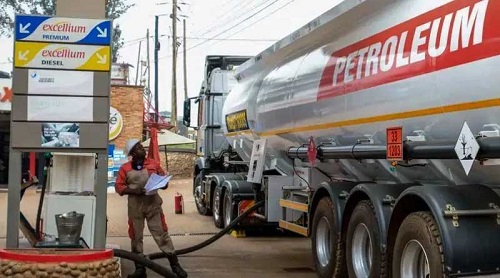
A fuel tanker dispensing fuel at one of Kampala’s petrol stations
HABARI DAILY I Kampala, Uganda I Ugandan businesses are facing an increasingly difficult operating environment as diesel prices surge past Shs7,290 per litre, triggering a cost-push inflation spiral that is threatening to undermine production, trade, employment and consumer spending.
The sharp increase in fuel prices is emerging as a heavy structural tax on the country’s productive economy, with businesses struggling to absorb rising transportation, manufacturing and distribution costs at a time when household purchasing power is already under pressure.
Diesel powers machinery
Diesel is particularly critical to Uganda’s economy because it powers much of the machinery and infrastructure that keep businesses running. From agricultural tractors and factory generators to cargo trucks transporting goods across the country, the fuel is deeply embedded in nearly every stage of production and distribution.
Consequently, its rising price is transmitting inflationary pressure across virtually every sector, leaving businesses with difficult choices between increasing prices, reducing operations or accepting shrinking profit margins.
For Uganda, a landlocked country heavily dependent on imported goods and road transportation, the effects are particularly severe. The movement of agricultural produce, industrial raw materials and finished products relies extensively on trucking, making businesses vulnerable whenever fuel prices rise.
Traders swallow additional costs
Transport operators are transferring the additional costs to traders, who in turn face the difficult decision of passing them on to consumers or absorbing them at the expense of their profits.
The cost of transporting a single bunch of matooke from production areas to urban markets, for instance, has reportedly increased from Shs2,000 to Shs5,000. Such increases may appear small in isolation, but their cumulative effect across thousands of consignments significantly raises the cost of doing business.
For market vendors and small-scale traders, the situation is becoming increasingly unsustainable. Raising prices risks driving away customers who are already struggling with the cost of living, while maintaining existing prices means sacrificing already limited profits.
The pressure is equally pronounced in manufacturing, where unreliable electricity supply forces some producers to depend on diesel-powered generators to maintain production.
With diesel inflation reportedly exceeding 42 per cent, the cost of operating these generators has risen sharply, adding to expenses associated with raw materials, labour, packaging and distribution.
Suspension of expansion plans
Manufacturers are consequently confronted with difficult decisions about whether to reduce production, suspend expansion plans, freeze capital investments or cut their workforce to remain operational.
The danger is that prolonged increases in production costs could weaken the competitiveness of locally manufactured products, while making imported alternatives relatively more attractive. This would undermine domestic industrialisation and threaten jobs in an economy that needs expanding productive capacity.
Beyond businesses, the diesel crisis is also affecting consumer demand, creating another challenge for traders and manufacturers.
As transportation and food prices rise, households are increasingly directing their limited incomes towards essential commodities such as beans, cassava, bread and other basic necessities.
This leaves little money for non-essential purchases, weakening activity in retail businesses dealing in clothing, electronics, household appliances and other consumer goods.
The transport sector is also feeling the consequences. As commuters struggle with increasing taxi and boda boda fares, some are opting to walk longer distances rather than spend money on daily transportation. This reduces the number of passengers available to commercial transport operators, further squeezing their earnings.
The situation is compounded by pressure on the exchange rate and the cost of credit. Because Uganda imports petroleum products using foreign currency, rising fuel import bills increase demand for dollars, adding pressure to the shilling, which has reportedly weakened beyond Shs4,100 against the US dollar.
A weaker currency creates additional difficulties for businesses that depend on imported machinery, industrial inputs, spare parts and packaging materials. Even enterprises that do not consume large quantities of diesel directly can therefore experience higher operating costs through imported inputs.
Inflation jumps to 5.8 per cent
Access to financing is another major concern. With annual headline inflation reported at 5.8 per cent, the Bank of Uganda’s monetary tightening, including a Central Bank Rate of 12 per cent, has made the cost of borrowing an additional burden.
Businesses experiencing cash-flow difficulties would ordinarily turn to commercial banks for working capital to maintain production, pay suppliers and meet operational obligations. However, expensive credit makes borrowing increasingly unattractive, particularly for small and medium-sized enterprises operating on narrow margins.
The combination of expensive fuel, currency depreciation, declining consumer demand and costly borrowing is creating a dangerous operating environment for businesses.
Ultimately, the greatest risk is that rising diesel prices could trigger a cycle in which higher production costs lead to higher consumer prices, reduced demand, lower business revenues and further job losses.
Without relief, businesses may increasingly scale down operations, postpone investments or close altogether, weakening employment creation and economic growth.
What makes the situation particularly worrying is that diesel is not merely another commodity whose price increase affects motorists. It is a critical input into Uganda’s productive economy. When its cost rises sharply, the consequences spread from farms and factories to markets, transport operators and households, threatening the economic survival of businesses across the country.







About the Author