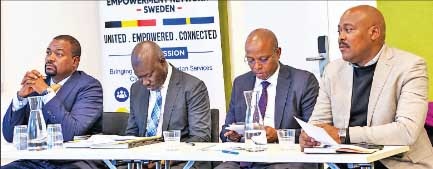
L-R: Kakuru, Bagonza, Kambere and senior presidential assistant and deputy head of diaspora Desk Henry Wabyona during the launch in Sweden last week
HABARI DAILY I Kampala, Uganda I In what appears to be solidarity at work, the State House Diaspora Unit has launched a network to unite Ugandans living in Sweden and strengthen their contribution to Uganda’s socio-economic development through investment, knowledge transfer, business partnerships and coordinated engagement with Government.
The launch, held in Stockholm, marks another milestone in the Government’s efforts to organise Ugandans living abroad into structured networks that can mobilise their skills, financial resources and professional connections to support national development.
The initiative is part of a wider diaspora mobilisation campaign that has already seen similar engagements conducted in Germany, Denmark, the United Kingdom and Zambia, with Government seeking to establish organised platforms through which Ugandans abroad can participate in the country’s economic transformation.
Through the networks, Government intends to move beyond conventional diaspora engagement, where contributions have largely been associated with individual remittances, towards a more coordinated approach that encourages investment, entrepreneurship, technology transfer and participation in national development programmes.
Speaking at the launch, Senior Presidential Advisor on Trade Phillip Kakuru said Government was increasingly recognising the diaspora as an important development partner whose contribution extends beyond sending money to relatives back home.
He said Ugandans living abroad possess valuable professional expertise, business networks, investment ideas and financial resources that could be harnessed to accelerate development if properly organised.
“The recently launched diaspora unit will serve as an organised bridge between Ugandans living in Sweden and the Government of Uganda, making it easier to share investment opportunities, access government programmes and co-ordinate diaspora contributions to national development,” Kakuru said.
He noted that the Stockholm launch brought together Ugandan community leaders, professionals, students, businesspeople and friends of Uganda, providing an opportunity to establish a common platform for engagement.
Kakuru urged Ugandans in Sweden to organise themselves, speak with one voice and use the network to transform their professional experience and international connections into practical opportunities back home.
He particularly identified agriculture, real estate, technology, tourism, manufacturing and trade as sectors where diaspora expertise and investment could generate significant economic benefits.
From scattered associations to organised networks
The launch addresses a longstanding challenge facing Ugandans living abroad: the fragmentation of diaspora communities into different associations, professional groups, cultural organisations and informal networks, which often operate independently.
Uganda’s Ambassador to Sweden, Margaret Mutembeya Otteskov, said Ugandans in the Scandinavian country had remained active in community activities for years but largely operated through scattered groups.
She welcomed the establishment of a common platform, saying it would enable Ugandans to coordinate their activities, strengthen relationships and engage Government more effectively.
Otteskov expressed optimism that the network would provide an opportunity for members to combine their strengths and pursue initiatives that benefit both their host country and Uganda.
“With this initiative, we can work together as one family and build something that benefits both Sweden and Uganda,” she said.
Her remarks underscore the importance of organised diaspora structures in addressing challenges such as limited coordination, duplication of activities and difficulties in identifying credible investment and development opportunities.
By bringing different groups under one umbrella, the State House Diaspora Unit hopes to create a platform through which community members can share information, identify common priorities and establish partnerships with institutions in Uganda.
Registration and investment programmes
Senior Presidential Advisor on Diaspora Affairs and head of the State House Diaspora Unit, Mohammed Bagonza, said the network would begin by registering community members, establishing leadership structures and developing a calendar of activities.
The registration exercise is expected to provide a clearer picture of the Ugandan population in Sweden, including professionals, entrepreneurs, students and other categories of diaspora members who could contribute to the network.
The planned activities will include investment webinars, cultural events, business forums and youth mentorship programmes.
Investment webinars and business forums are expected to provide opportunities for Ugandans abroad to learn about available investment opportunities, engage relevant Government agencies and establish partnerships with businesses operating in Uganda.
The youth mentorship programmes, meanwhile, are intended to connect experienced Ugandan professionals in Sweden with young people, potentially facilitating knowledge exchange, career guidance and professional development.
Cultural events will also provide opportunities to preserve Uganda’s cultural identity, strengthen community relationships and promote the country’s image in Sweden.
Bagonza said the initiative was part of a wider strategy to ensure Ugandans abroad are actively involved in national planning, investment and development discussions.
“The Sweden launch is part of a wider effort by the State House Diaspora Unit, aimed at organising and mobilising Ugandans abroad into strong, structured networks to ensure the diaspora is not left out of planning, investment and national dialogue across Europe and beyond,” he said.
His remarks reflect Government’s intention to institutionalise diaspora participation rather than relying solely on occasional meetings and individual engagements.
Mobilising diaspora resources
Ugandans living abroad represent an important source of foreign exchange through remittances, but Government increasingly wants to expand their contribution into productive investments, business development and skills transfer.
The proposed networks could help connect diaspora investors with opportunities in Uganda’s agriculture, property development, manufacturing, tourism and technology sectors.
For instance, Ugandan professionals working in Sweden’s technology, engineering, healthcare, financial services and manufacturing industries could potentially share expertise with institutions and businesses back home.
Similarly, entrepreneurs and investors could use the network to identify credible business partners, explore investment opportunities and navigate Government programmes.
The initiative could also strengthen commercial links between Uganda and Sweden by encouraging business partnerships, trade connections and professional exchanges.
However, the effectiveness of the network will depend on its ability to translate community registration and engagement activities into measurable economic outcomes, including investment commitments, business partnerships and skills-transfer initiatives.
Officials attend Stockholm launch
The launch attracted several Ugandan officials and diaspora representatives, reflecting the Government’s intention to bring together different institutions involved in immigration, community engagement and diaspora affairs.
Among those who attended were Col. Geoffrey Brian Kambere, Acting Chief of Citizenship and Immigration Control under the Ministry of Internal Affairs; Bridget Akanga, president of the Ugandan Community in Sweden; and Dorothy Nsereko, Under Secretary in the Ministry of Internal Affairs.
Other participants included diaspora leaders Boaz Murinzi from Germany and Idris Kironde, among others.
Their participation provided an opportunity to exchange experiences on diaspora organisation and the development of structured community networks across different countries.
The involvement of officials from the Ministry of Internal Affairs also highlights the importance of coordination between Government institutions and Ugandan communities abroad.
Building a stronger connection
The Sweden initiative adds to the State House Diaspora Unit’s expanding efforts to establish organised Ugandan networks across Europe and other regions.
By creating formal structures for engagement, Government hopes to make it easier for Ugandans abroad to access information, participate in investment programmes and contribute to national development priorities.
For the Ugandan community in Sweden, the immediate priority will be building an inclusive leadership structure, registering members and developing activities that respond to their interests and capabilities







About the Author