
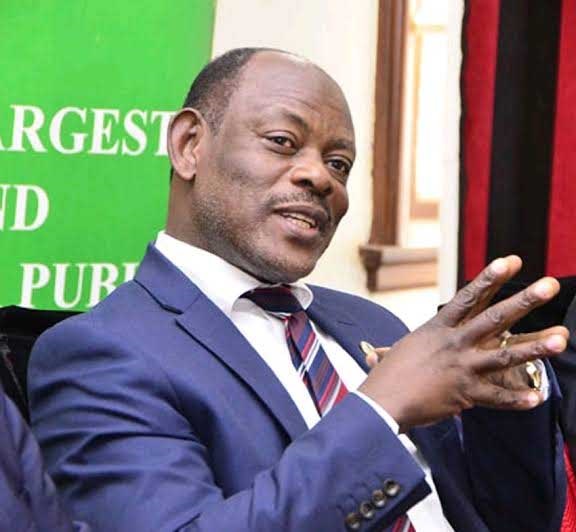
Prof. Barnabas Nawangwe
HABARI DAILY I Kampala, Uganda I His service in the education sector, spanning more than three decades in academic leadership, research and university administration, has earned Makerere University Vice Chancellor Prof. Barnabas Nawangwe another major national responsibility after President Yoweri Kaguta Museveni appointed him Chairperson of the National Council for Higher Education (NCHE).
The appointment, made through an official instrument dated November 14, 2026, was announced on Tuesday, November 24, by NCHE Executive Director Prof. Mary Okwakol.
Nawangwe will serve a five-year term, effective from the date he assumes office, placing him at the helm of the statutory institution responsible for regulating and ensuring quality in Uganda’s higher education sector.
According to the appointment instrument, Museveni exercised his authority under Sections 4, 7(1)(a) and 7(2) of the Universities and Other Tertiary Institutions Act, acting on the recommendation of the National Council.
He succeeds Prof. Joy Constance Kwesiga, who had been serving as the council’s chairperson following a prolonged leadership dispute that arose from the controversial reappointment of former chairperson Prof. Eli Katunguka Rwakishaya.
Katunguka’s initial five-year tenure expired in March 2024. Although he was subsequently reappointed in June 2024, questions emerged regarding procedural irregularities surrounding his reappointment, particularly whether the statutory requirements for appointing a council chairperson had been followed.
The Attorney General’s guidance emphasised that the chairperson should be selected from serving council members and that the council should recommend two members to the President for consideration. The controversy consequently left the council’s leadership in uncertainty, with Kwesiga taking charge in her capacity as vice chairperson.
Nawangwe’s appointment comes at a significant point in his career, as he approaches the conclusion of his second five-year term as Makerere University Vice Chancellor.
He first assumed the university’s top administrative position in September 2017, succeeding Prof. John Ddumba-Ssentamu. In August 2022, he was reappointed for another five years following a recommendation by the university council.
An architect by profession, Nawangwe holds a PhD in Architecture from Kyiv National University of Construction and Architecture in Ukraine.
His career at Makerere University dates back to 1989, when he joined the institution as a lecturer. He subsequently served as Head of the Department of Architecture from 1989 to 2002, Dean of the Faculty of Technology from 2002 to 2011, and Principal of the College of Engineering, Design, Art and Technology between 2011 and 2013.
Between 2013 and 2017, he served as Deputy Vice Chancellor in charge of Finance and Administration before becoming Vice Chancellor.
He has also published more than 40 articles in peer-reviewed journals and participated in several national and international academic and professional boards.
His new assignment places him in charge of an institution whose mandate includes registering higher education institutions, accrediting academic programmes, investigating complaints, monitoring universities and ensuring that minimum academic standards are maintained.
NCHE also advises Government on the establishment of universities and other tertiary institutions, coordinates national admission standards and determines the equivalence of academic qualifications obtained outside Uganda.
However, his appointment also presents an important institutional responsibility because Makerere University, which he continues to lead, falls under the regulatory oversight of NCHE.
The need to maintain transparency and impartiality in regulatory decisions involving Makerere and other universities will therefore be an important consideration during his tenure.
Nawangwe’s extensive experience in university administration and higher education is expected to be central to his new responsibilities as he takes charge of the institution mandated to safeguard the quality and credibility of Uganda’s higher education system.







About the Author