
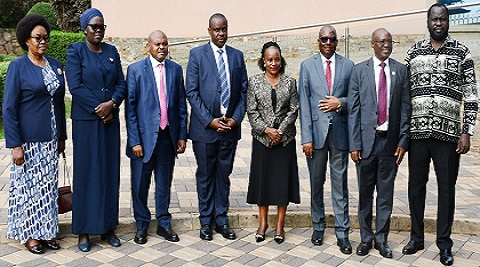
Balaam Barugahara (4th Left), the minister of Local Government, Isaac Musumba (3th Left), commissioners Sumbua Naima, and Emma Boona, among other commissioners during the deliberations at the Local Government Finance Commission negotiations for FY 2027/27 at Mestil Hotel, Kampala on 18th August 2026 (Photo by Brenda Nantundi)
HABARI DAILY I Kampala, Uganda I Contractors in the education sector who have been delivering sub standard work are to answer for their wrongs, Local Government Minister Balaam Barugahara has warned, as government intensifies efforts to fight corruption and misuse of public funds in the implementation of projects at the local government level.
Barugahara said corruption was undermining government investment in education and other essential services, with poor workmanship and abandoned or defective projects depriving communities of facilities they desperately need.
“You cannot go to a school where we are funded and you find the toilet is full and our children are going to the toilet, competing with maggots. So some of these things have been caused by corruption,” Barugahara said.
Speaking during the launch of the Financial Year 2027/28 national grant negotiations between central and local governments, he said the fight against corruption should not be treated as an individual or political campaign, but as a national responsibility.
Organised by the Local Government Finance Commission (LGFC) between 17th – 25thAugust, the negotiations have brought together officials from MDA as well as local governments.
Said Balaam: “Whatever we do, we must therefore stop putting the fight against corruption as Barugahara’s fight or anybody’s fight. It’s not President Museveni’s fight, it’s not anyone’s fight, it’s the fight for Uganda.”
Enforcement of accountability
The minister urged local government leaders, contractors, communities and other stakeholders to support enforcement of accountability measures and ensure that public resources achieve their intended purpose.
“I appeal to you, the representative of both groups, let us join the fight, let us support compliance, let us support the law enforcement agenda. It is fundamental to service the Ugandan agenda,” he said.
Barugahara said every shilling lost through corruption represented an opportunity denied to citizens, particularly in critical sectors such as education, health, roads and water.
“Every shilling lost to corruption is a shilling that cannot build a classroom, it cannot support a health facility, it cannot maintain roads, provide clean water, it cannot strengthen a productive community,” he said.
He called for integrity, transparency and patriotism to become central to the financing and implementation of government programmes, while urging officials to identify weaknesses in governance and financial controls that enable public money to be lost, misused or stolen.
Barugahara cited examples of what he described as unacceptable construction practices in local governments, including education-related infrastructure that fails to meet basic standards.
“Some pit latrines constructed using public funds had allegedly been commissioned despite lacking the basic infrastructure expected of a functional toilet.”
Funding for public services
He warned that such failures could no longer be tolerated at a time when government and taxpayers were struggling to provide adequate funding for public services.
The minister also called for stronger procurement and contract management systems to prevent individuals from abusing their positions.
He cited a case in Mbarara where a town clerk allegedly sent away the procurement officer and took over procurement and payment processes, creating what he described as excessive concentration of power.
“The town clerk has been the god of the city,” he said. “You should avoid all these things. You should try to follow the system, put it in place, and then implement your workload within agreed standards.”
He further urged communities and journalists to monitor government-funded projects, particularly classrooms, toilets and other school infrastructure.
“If you do have the community and take on the oversight, let journalists cover it, let everybody know that this is what we intend to do in our given district,” he said.
Public Awareness Crucial
He said public awareness could make it increasingly difficult for contractors and officials to steal resources without detection.
“We must make it increasingly difficult for public resources to be stolen and increasingly certain that misuse will be detected and we shall act,” Barugahara said.
The minister also appealed to officials not to engage in practices that compromise accountability, warning that he would not tolerate demands for unofficial payments during his visits to districts.
“I’m not your minister who will come for fuel when I come to a district. Please don’t prepare an envelope for me. Let’s do the right thing,” he said.
Isaac Musumba, the Chairman of the LGFC, said the negotiations provide an important platform for local governments to account for resources received while identifying areas requiring additional financing.
“Local government negotiation meetings are key to the decentralization process,” Musumba said, explaining that the meetings fulfil the constitutional requirement for funds to be transferred to local governments on the advice of the LGFC.
Adam Babaale, the secretary to the Local Government Commission said that effective decentralisation depends not only on the amount of money transferred, but also on how well resources are matched with responsibilities and translated into better services.







About the Author