
Gov’t Plans Seven Public Free Zones To Drive Uganda’s Export-led Economy
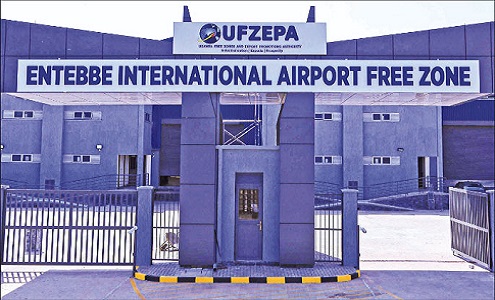
Entebbe International Airport Free Zone, the only public free zone in Uganda
HABARI DAILY I Kampala, Uganda I Uganda Government’s strategy to establish an export-led economy are likely to bear fruit soon following the plan to establish seven new public free zones, each expected to cover about 10 square kilometres, in a move aimed at accelerating industrialisation, creating jobs and expanding Uganda’s export base.
The proposed free zones are expected to be established in different parts of the country and will provide designated spaces where industries can access shared infrastructure, logistics and other services while benefiting from incentives designed to promote export-oriented production.
Uganda currently has only one public free zone, located at Entebbe International Airport, meaning the planned expansion represents a major shift in the Government’s approach to developing industrial infrastructure outside the Kampala-Entebbe corridor.
The Uganda Free Zones and Export Promotion Authority (UFZEPA) says the new zones will also help the country move away from exporting raw materials by encouraging value addition and the production of goods for regional and international markets.
Seven zones planned
According to UFZEPA, the proposed zones will be spread across various parts of Uganda, with some planned around strategic border points and others serving wider regional economic centres.
Moyo and other border areas, including Kyotera and Kasese, have been identified as potential locations, while regional zones are planned for Mubende and Moyo to stimulate trade and economic activity.
The Government has tasked UFZEPA with conducting feasibility studies and master planning for the proposed sites before construction and development can begin.

Doreen Kembabazi
Doreen Kembabazi, UFZEPA spokesperson, said the authority is currently undertaking the groundwork required to determine whether the proposed locations are suitable for the developments.
“This financial year, we were tasked by the Government with doing feasibility and master planning in the areas we proposed,” Kembabazi said.
She explained that the studies will help determine the suitability of the different locations and guide the development of infrastructure and investment plans.
Her remarks were made during a two-day workshop in Kampala organised by the Global Green Growth Institute in collaboration with TradeMark Africa and DANIDA.
The workshop examined management models, infrastructure planning, revenue generation, investor services and the economic viability of industrial parks and special economic zones.
Zones to target different industries
The proposed free zones are expected to have different areas of specialisation based on the economic potential and resources available in their respective regions.
Around the Moyo border area, the plan envisages the development of agro-processing, livestock and logistics activities.
The wider West Nile zone is expected to support agro-processing, livestock, financial services, information and communication technology, education and tourism.
Northern Uganda, meanwhile, is being considered for agro-processing, mineral value addition, livestock and convention services.
Central Uganda is earmarked for agro-processing, light manufacturing, packaging, pharmaceuticals, ICT, science and technology.
The eastern Uganda zone is expected to focus on mineral processing, agro-processing, financial services, tourism and recreation.
The strategy is designed to ensure that the zones are not simply industrial estates but specialised economic centres capable of attracting investors whose activities complement one another.
Shared infrastructure to lower costs
Eve Oke Lwonge, UFZEPA senior investor support officer, said the zones would create economic opportunities by concentrating complementary industries and services in designated areas.
According to Lwonge, businesses operating within the zones would be able to share infrastructure, utilities, logistics and other services, potentially reducing the cost of establishing and operating businesses.
Such concentration is expected to create industrial ecosystems in which manufacturers, processors, suppliers, transporters and service providers operate close to one another.
For Uganda, this could help address some of the infrastructure and logistics challenges that have traditionally increased the cost of doing business and made locally manufactured products less competitive on international markets.
Adding value to raw materials
Kembabazi said one of the major objectives of the free-zone programme is to enable Uganda to add value to its abundant raw materials before they are exported.
Rather than exporting agricultural commodities, minerals and other raw materials in largely unprocessed form, Government wants industries located in the zones to process them into higher-value products.
She said the free zones would provide an opportunity for Uganda to strengthen domestic supply chains and increase both the volume and value of goods destined for regional and international markets.
The approach is also expected to generate employment, particularly for young people, by encouraging investment in manufacturing, agro-processing, logistics, technology and other sectors.
A free zone is a designated geographical area in which special customs and tax arrangements apply to facilitate export-oriented production. UFZEPA describes it as an area exempt from customs duties and taxes on imported inputs and exported outputs, with the broader objective of supporting the production of competitive goods and services for export.
Management could determine success
While Government’s plan is ambitious, stakeholders at the workshop cautioned that physical infrastructure alone will not guarantee the success of the proposed zones.
Rebecca Nalumu Wamono, senior manager at the Global Green Growth Institute, called for professional management of the facilities and efficient services for investors.
“The development of Uganda’s free zones and industrial parks will not be determined by how much infrastructure we have but how professionally we manage and how effective our services will be to investors, how sustainably we fund the zones and how continuously we improve our performance,” Wamono said.
Her comments highlight one of the central challenges facing Uganda’s industrialisation strategy: ensuring that public investments translate into productive enterprises rather than underutilised industrial facilities.
The Government will therefore have to ensure that investors can access reliable utilities, efficient transport networks, transparent regulatory services and other facilities necessary for competitive production.
Uganda can learn from South Africa
Henry Nuwarinda, principal project manager for the Global Eco-Industrial Parks Programme in South Africa, said Uganda could learn from South Africa’s experience in developing industrial parks.
He cautioned against viewing the establishment of industrial parks merely as an infrastructure project.
“The lesson for Uganda is that establishing industrial parks is only the beginning. We must move beyond developing infrastructure to building well-managed, competitive and sustainable industrial ecosystems,” Nuwarinda said.
He added that pilot projects could demonstrate what works, but the bigger challenge would be scaling successful models across Uganda’s industrial park portfolio.
The advice comes as Government seeks to transform Uganda from an economy that exports significant quantities of unprocessed commodities into one increasingly driven by manufacturing and value-added exports.
A test for export ambitions
The seven proposed free zones could become an important pillar of that transformation if Government successfully combines infrastructure development with investor-friendly management and reliable services.
Their strategic distribution across the country could also help spread industrialisation beyond the traditional Kampala-Entebbe axis, bringing investment and employment opportunities closer to producers and raw-material sources.
For UFZEPA, the ultimate measure of success will be whether the zones increase Uganda’s capacity to produce competitive goods for international markets, since feasibility studies and master planning is now under way.
About the Author