
HABARI DAILY I Kampala, Uganda I Kenya has so far been three times unlucky after recording its third Ebola infection on Friday, October 16, 2026, with the latest case involving a 65-year-old woman who is closely related to the first two patients.
The woman, who had been in quarantine since October 6, tested positive for the Bundibugyo strain of Ebola after developing symptoms, raising concerns about the spread of the virus from the Democratic Republic of the Congo (DRC) into neighbouring countries.
Kenya’s Ministry of Health said the patient had been under observation when she developed symptoms, enabling health workers to isolate her and conduct tests.
“Once she developed fever, sore throat and malaise, she was isolated and specimen collected for testing,” the ministry said in a statement. “She was diagnosed early and is currently receiving supportive care improving her chances of recovery.”
The latest infection brings Kenya’s confirmed Ebola cases to three, including one death, since the country recorded its first-ever case earlier this month.
In a statement, the World Health Organization (WHO) confirmed that the second and third patients were close family members of the first case and had already been quarantined before developing symptoms on October 14 and October 16, respectively.
The first patient, a Kenyan man who had travelled home from the DRC, died on the night of October 5 after arriving in Nairobi on October 3. He had reportedly been ill in the DRC for about a month before travelling by road through Uganda and subsequently flying to Kenya.
His death prompted health authorities to identify 130 people who had come into contact with him, including relatives, friends, healthcare workers and passengers who travelled on the same flight.
By October 16, 127 of the 130 identified contacts had been placed under quarantine, with health teams conducting daily temperature checks and monitoring symptoms for 21 days.
“Being quarantined means the family and the general public are better protected from exposure to the virus, hence reducing chances of community transmission,” said Dr Neema Rusibamayila Kimambo, WHO Representative to Kenya.
The organisation said the early detection of the two subsequent infections demonstrated the importance of quarantine and surveillance in containing the outbreak.
“This is the response working as designed,” said Dr Patrick Amoth, Director General for Health at Kenya’s Ministry of Health.
The ministry has maintained that there is no evidence of community transmission, although officials have warned that additional cases could emerge among people already in quarantine before the monitoring period ends.
WHO said both new patients were receiving supportive care in designated treatment units. The treatment includes fluids to prevent dehydration and medical attention to manage symptoms.
Kenyan authorities reported that the second patient was in stable condition and responding well to supportive care.
The Bundibugyo strain can initially cause symptoms resembling malaria and other common illnesses, including fever, fatigue, muscle and joint pains, headaches and sore throats. In more advanced stages, patients may develop vomiting, diarrhoea and impaired kidney and liver functions.
The virus spreads through direct contact with the blood or other bodily fluids of infected people, including those who have died, or objects contaminated with such fluids. It is not transmitted through the air.
There is currently no licensed vaccine or specific treatment for Bundibugyo Ebola, although vaccine and treatment trials are under way in the DRC. WHO says early supportive care improves patients’ chances of survival.
Kenya’s outbreak has also raised questions about screening at regional borders and airports after the first patient travelled through Uganda, where the land border with the DRC had reportedly been closed since May, before reaching Nairobi’s Jomo Kenyatta International Airport.
However, WHO has advised against closing borders or restricting trade, saying Kenya remains open to travel, commerce and public gatherings.
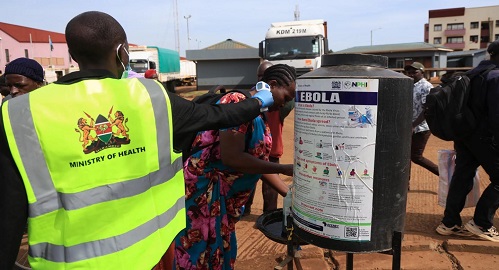
Kenya began preparing for a possible Ebola case in May, when the outbreak was declared in the DRC. Nearly 5,000 health workers have since received training to recognise the disease and safely manage patients.
WHO is supporting Kenya’s response through surveillance, contact tracing, laboratory testing, infection prevention, patient care and screening at points of entry. It has also supplied protective equipment, Ebola testing kits and infrared thermometers worth approximately $70,000.
The wider regional concern follows a major Ebola outbreak in the DRC, where infections have exceeded 9,000 and deaths have surpassed 4,000, according to health officials.
Uganda, which reported cases in May and June, was declared free of the virus in August.
As Kenya continues monitoring the remaining contacts, health authorities are relying on quarantine, early diagnosis and rapid treatment to prevent further infections and contain the outbreak before it spreads into the wider community.







About the Author