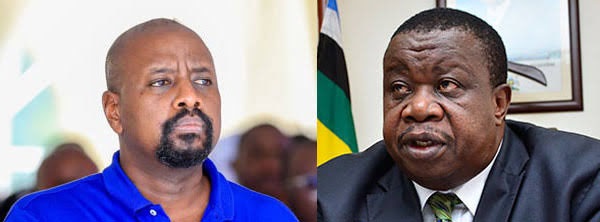

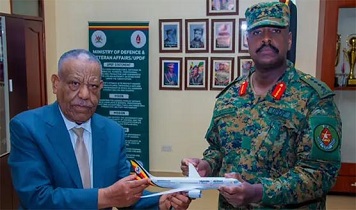
Gen. Muhoozi (R) met the Uganda Airlines Acting Chief Executive Officer Girma Wake at his office today
HABARI DAILY I Kampala, Uganda I Chief of Defence Forces Gen. Muhoozi Kainerugaba has thrown his weight behind Uganda Airlines’ expansion plans, describing a stronger national carrier as an important pillar in Uganda’s ambitions to grow trade, tourism, regional integration and the wider economy.
Kainerugaba expressed his support when Uganda Airlines executives briefed him on the carrier’s expansion strategy at the Special Forces Command headquarters in Entebbe. The delegation was led by Acting Chief Executive Officer Girma Wake and included Chief Finance Officer Allan Joel Kyeyune, Acting Manager for Human Resource and Administration Anne Apio and Acting Chief Commercial Officer Shakila Lamar Rahim.
At the strategic meeting, the airline’s management outlined plans to make better use of its existing fleet, open new international routes and introduce domestic flights as it seeks to strengthen its position in the increasingly competitive African aviation market.
Kainerugaba welcomed the plans and pledged institutional support, arguing that a national airline capable of connecting Uganda directly to major markets could play a critical role in advancing the country’s economic interests.
His backing comes at a time when Uganda Airlines is pursuing an ambitious growth programme that management says goes beyond simply acquiring more aircraft.
The carrier plans to expand its network from Entebbe to destinations in Africa, Asia, Europe and the Middle East. It is also seeking to increase regional connectivity while introducing domestic services to improve movement between different parts of Uganda.
For Kainerugaba, such connectivity has significance beyond passenger travel. A reliable national carrier can facilitate the movement of businesspeople, investors and goods, helping Ugandan enterprises access regional and international markets more easily.
The expansion could also support Uganda’s tourism industry by making the country more accessible to international visitors. Direct and convenient connections can reduce the travel barriers faced by tourists while positioning Entebbe as an increasingly important gateway into Uganda.
The airline’s growth is therefore closely linked to another strategic objective: strengthening Entebbe International Airport as a regional aviation and transit hub.
Uganda Airlines currently operates 17 destinations in 13 countries from Entebbe and has announced new direct services to Accra and Kigali. The additional routes are intended to increase connectivity while improving the airport’s role as a link between East Africa and the wider world.
Management, however, recognises that expansion without financial discipline could expose the carrier to higher operating costs. It has therefore placed cost reduction and operational efficiency at the centre of its strategy.
One of the key proposals is to bring more aircraft maintenance and ground-handling services in-house. The move is expected to reduce reliance on external service providers, lower costs and improve operational reliability.
Internalising technical services would also create opportunities to train and employ more Ugandans in specialised aviation fields, gradually building the country’s own technical capacity.
Wake has previously emphasised that aircraft alone cannot make a successful airline. The carrier is also working to strengthen its people, cargo operations, passenger facilities, maintenance capabilities and other operational infrastructure.
The airline’s expansion is further backed by a major fleet investment. Uganda Airlines has placed its first Boeing order for four 737-8 MAX aircraft and four 787-9 Dreamliners, giving it additional capacity to serve both regional and long-haul markets.
The challenge now is to ensure that the enlarged fleet translates into a profitable and sustainable operation.
This is where Kainerugaba’s emphasis on a globally competitive and profitable national carrier becomes significant. His support appears rooted not merely in national pride but in the strategic economic value of aviation to a landlocked country seeking stronger links with global markets.
For Uganda, an efficient national airline can help reduce dependence on foreign carriers, retain more aviation-related spending within the country and provide a platform for expanding trade and tourism.
The carrier’s management says continued government and industry support will be critical to implementing the strategy. Kainerugaba’s backing therefore provides a significant vote of confidence as Uganda Airlines seeks to move from stabilising its operations to building a larger and more competitive network.
The broader objective is clear: to build an airline that does more than fly passengers. Uganda Airlines is being positioned as an instrument for connecting the country to markets, tourists, investors and opportunities across Africa and beyond.
If successfully implemented, the expansion could make the national carrier an important component of Uganda’s economic and regional integration strategy.







About the Author