
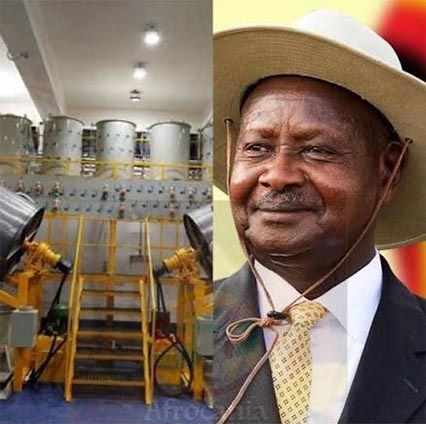
President Museveni. On the left is Euro Gold Refinery (U) SMC Ltd, one of the first fully Ugandan-owned gold refinery
HABARI DAILY I Kampala, Uganda I President Yoweri Museveni has alleged that a network of corrupt officials operating within State House plotted to kill a foreign gold refinery developer identified only as Cohen, while accusing veteran journalist Andrew Mwenda of attempting to shield criminal elements and undermine efforts to expose corruption and abuse within government institutions.
In a lengthy statement released on Monday, Museveni responded directly to Mwenda’s recent commentary concerning Stephen Nuwagaba, dismissing claims that the young man had infiltrated State House and security agencies. Instead, the President portrayed Nuwagaba as a victim of torture who had been rescued after allegedly being targeted by rogue security personnel.
However, beyond the defence of Nuwagaba, the President made explosive allegations involving officials within State House, claiming they orchestrated a campaign against Cohen, a gold refinery developer.
According to Museveni, the group not only robbed the investor but also planned to eliminate him physically.
“The gang of criminals in State House led by somebody called Itungo that were robbing a Gold Refinery Developer known as Cohen and even planning to kill him are still being covered up by elements in some of the structures,” Museveni stated.
The President did not identify Cohen further or disclose the period during which the alleged incidents occurred. Neither did he reveal whether criminal prosecutions have been initiated against the individuals he accused.
Instead, Museveni argued that the continued protection of such officials demonstrated the existence of entrenched criminal networks inside state institutions.
Government structures compromised
He said these networks had frustrated formal government structures, making it necessary for him to rely on informal sources of intelligence to uncover corruption and criminality.
Museveni cited the Cohen matter alongside what he described as corruption involving access to State House, where individuals allegedly demanded bribes from citizens seeking appointments with him.
He also referenced the handling of opposition politician Dr. Kizza Besigye’s case and the government’s response to last year’s Gen-Z protests as examples where informal intelligence channels proved more effective than established security structures.
The President accused some security personnel of deliberately suppressing intelligence reports and protecting criminal actors.
According to him, Uganda’s biggest challenge is not individuals such as Stephen Nuwagaba but rather compromised officers embedded within security agencies.
“The main problem of the country is not Nuwagaba seizing State House and the Security Forces but the criminals, including some in the Security Forces and other organs, that have been blocking the flow of information about the criminals, covering them up and ensuring information does not reach leaders like the President so that they can continue with their criminality,” Museveni wrote.
Medical evacuation
The President also alleged that Nuwagaba had become the target of a coordinated campaign after exposing wrongdoing.
He revealed that the young man had sought refuge under his protection after allegedly being tortured, maimed and threatened with death by elements within the security services.
Museveni disclosed that he personally facilitated Nuwagaba’s medical treatment in Uganda and abroad because of the severity of his injuries.
According to the President, some of those allegedly responsible are already facing criminal proceedings before court.
He further claimed that Nuwagaba’s mother was also tortured while his father had received repeated threats despite being an NRM supporter and an elected LC1 chairperson.
Museveni said investigations into those allegations were already underway.
The President used the statement to launch a scathing attack on Andrew Mwenda, accusing him of attempting to divert public attention away from corruption and criminal conduct.
Museveni alleged that Mwenda’s criticism formed part of a broader effort to discredit whistleblowers while protecting individuals implicated in wrongdoing.
Enshrined corruption
He questioned why the journalist had focused his investigations on Nuwagaba instead of examining alleged corruption in programmes such as the Parish Development Model (PDM), road construction projects and other government institutions.
“Could it be that the aim of Mwenda was to frighten the patriots from exposing corruption and criminality?” Museveni asked.
The President also rejected suggestions that Nuwagaba had somehow taken over State House or infiltrated Uganda’s security establishment.
Instead, Museveni described him as a traumatised young man who, despite any personal shortcomings, could not reasonably be portrayed as the country’s principal security threat.
Even if allegations against Nuwagaba regarding dishonesty or soliciting money from members of the public proved true, Museveni maintained that such issues paled in comparison to corruption within security agencies and other public institutions.
He argued that public complaints he encountered during his recent nationwide campaigns centred on the diversion of PDM funds, the sale of government jobs and corruption in road projects rather than on Nuwagaba’s conduct.
Museveni further reaffirmed his government’s opposition to torture, describing the practice as immoral, counter-revolutionary and strategically self-defeating.
Decades in political struggle
He insisted that throughout his more than five decades in political struggle, he had never sanctioned torture or extrajudicial killings.
While acknowledging that Uganda’s security agencies had been infiltrated by corrupt and unpatriotic elements, the President warned security forces against fighting impunity through unlawful methods.
He maintained that those responsible for torture, maiming and extrajudicial killings undermine both the moral legitimacy and strategic objectives of the state.
The President contrasted those actions with disciplinary measures employed during the liberation struggle, arguing that punishment should focus on correcting behaviour rather than inflicting permanent physical harm.
Informal intelligence networks reliable
Throughout the statement, Museveni repeatedly defended the role of informal intelligence networks, arguing that they have historically complemented formal intelligence gathering both during the liberation war and under his government.
He cited military operations during the National Resistance Army bush war as examples of successful cooperation between human intelligence and technical intelligence before extending the same argument to present-day governance.
According to Museveni, the reliance on informal intelligence has become necessary because some officials within formal institutions have become corrupt or compromised.
The President concluded by urging Ugandans to remain focused on exposing corruption, criminality and abuse of office instead of being distracted by what he described as attempts to shift public attention toward less significant controversies.
His statement signals an intensifying public dispute with Mwenda while raising fresh questions about the President’s allegations of criminal activity inside State House and within sections of Uganda’s security establishment.







About the Author