
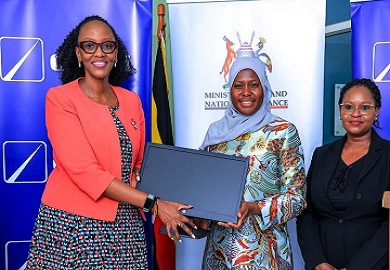
L-R: Helena Mayanja, Dr Amina Zawedde and Mable Ndawula during the handover ceremony held today, July 21st 2026 at the National ICT Innovation Hub in Nakawa
The donation forms part of a broader Memorandum of Understanding (MoU) between dfcu Foundation and the Ministry aimed at accelerating Uganda’s digital skilling agenda and expanding opportunities for underserved communities across the country.
Speaking during the handover ceremony, the Permanent Secretary at the Ministry of ICT and National Guidance, Dr Amina Zawedde, praised dfcu Bank for translating its commitment into tangible support.
“The Ministry of ICT does not work alone when we are digitising. We work with the private sector, development partners, government institutions and many others because digital transformation is a collective responsibility,” she said.
Private sector partnerships
She revealed that the ministry deliberately sought partnerships with the private sector because government alone cannot provide enough digital devices for Uganda’s rapidly growing and youthful population.
Dr Zawedde explained that digital infrastructure, digital services, digital skills, cybersecurity, and innovation are the five pillars of Uganda’s Digital Transformation Roadmap, all designed to support the country’s economic transformation agenda.
“We need connectivity, fibre everywhere, data centres, computers, smartphones and all the devices that enable us to get there. We need to be AI-enabled, but we also have to build digital services and, most importantly, digital skills because people have to know how to use technology.”
She stressed that digital literacy has become just as important as conventional literacy.
“Long ago people were taught how to read, write and count. Today we also have to teach people how to use technology. If government says passport applications, national IDs or driving permits are online, how can citizens access those services if they lack digital skills?”
According to Dr Zawedde, access to devices remains one of the biggest barriers to digital inclusion.
“We can’t skill people if we don’t have the devices. We can’t learn if we don’t have the computers.”
She said this reality prompted the ministry to ask private companies to donate computers they replace after routine upgrades instead of disposing of them.
Schools to benefit
The Permanent Secretary noted that the computers will be distributed across the country to institutions that require them most, with transparency guiding the entire process.
“The ministry will ensure that the computers are distributed transparently to the intended schools and used for their stated purpose. We call upon the beneficiary schools to safeguard the equipment, maintain it properly and make it accessible to learners.”
She added that the collaboration aligns with Uganda’s National Development Plan IV, the Digital Uganda Vision and the Digital Transformation Roadmap, all of which seek to build human capital and ensure no Ugandan is left behind in the digital economy.
Helena Mayanja, dfcu Bank’s Head of Corporate Affairs and Sustainability, said that through this partnership, they are committed to strengthen Uganda’s digital landscape, supporting the youth and women-led enterprises.
Leveraging ICT for development
“We want everybody in Uganda to improve their livelihoods by leveraging ICT,” Mayanja said, adding that the partnership is helping translate government commitments into practical interventions that expand digital access and opportunity across the country.
Mabel Ndawula, the Executive Director dfcu Foundation, hailed Dr Amina Zawedde for being the driving force behind Uganda’s digital transformation agenda.
“She has championed, and continues to champion, innovation, digital inclusion and partnerships that create opportunities for citizens across the country,” she said.







.
About the Author