
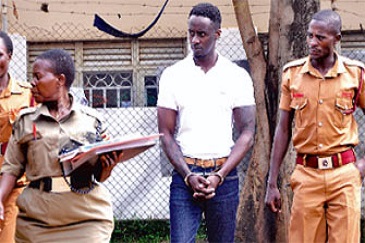
Patrick Kashaija, alias Pato (Centre), leaving court recently, before he was vindicated
HABARI DAILY I Kampala, Uganda I For Patrick Kashaija, alias Pato, the conviction and sentencing of the people who kidnapped and murdered Susan Magara brought back painful memories of a nightmare that began more than eight years ago.
As the court recently handed down punishment to those found responsible for Magara’s kidnap and murder, questions emerged over why Kashaija, once presented as one of the key suspects in the high-profile case, was not among those standing in the dock awaiting the court’s sentencing.
For many Ugandans, Pato appeared to have been one of the men who would eventually face the full force of the law. His name had been linked to the case after investigators attributed to him an audio recording in which the kidnappers demanded a ransom from Magara’s family.
But while the suspects convicted in the case have now received their sentences, Kashaija is a free man, having had the charges against him dropped by the Office of the Director of Public Prosecutions (ODPP) after further investigations established that the voice on the ransom recording was not his.
Instead, investigators reportedly established that the voice belonged to Yakub Byensi. For Kashaija, however, the journey to that vindication was far from easy.
His ordeal began thousands of kilometres away from Uganda, in South Africa, where he had been living since 2013.
A night raid in South Africa
Kashaija recalls March 7, 2018, as the night his life changed dramatically. It was around 9:00pm when he heard loud bangs on the door of his house in South Africa. At the same time, a helicopter was hovering above his home.
Curious about what was happening, he walked to the balcony. He says he then heard people downstairs ordering him to freeze or risk being shot.
The officers were not in uniform, and the bright light from the helicopter made it difficult for him to see them clearly.
“I raised my hand,” he recalls. What followed, he says, was brutal.
The men allegedly kicked him, breaking his nose, before handcuffing and chaining him. They pushed him into the house and began searching his property. Kashaija says the search continued from about 9:00pm until 3:00am.
The officers moved around the house collecting several items. They later went to the parking area and deflated the tyres of his vehicles before taking him away.
As they drove him from Johannesburg towards Pretoria, Kashaija says he remained convinced that he had been kidnapped. The men were driving unmarked vehicles and had not initially explained why they had arrested him.
He says the officers asked how long he had lived in South Africa. He told them he had been staying there since 2013.
They also asked when he had left Uganda.
When he answered that he had left a few days earlier, the officers allegedly told him that he had been “doing the same thing” for a long time.
Kashaija did not understand what they meant. When he asked what “thing” they were referring to, he says they told him to ask his President. But there was little opportunity for him to seek answers.
The officers drove him to Pretoria, where they handed him over to Brooklyn Police before leaving.
Everything taken from his house was recorded in an inventory, which he signed, and he was booked into custody.
It was only the following day that Kashaija says he was finally told what he was accused of.
The Magara accusation
According to Kashaija, the officers who came for him the following day identified themselves as investigators.
They told him he was being accused of kidnapping someone, receiving ransom money and fleeing to South Africa for safety.
The accusation was linked to the February 2018 kidnap and murder of Magara, a young Ugandan woman whose disappearance and subsequent killing had shocked the country.
Kashaija says he immediately asked for a telephone so that he could inform his family. He was eventually taken to court, where the charges were formally read to him. It was at this point that he discovered the seriousness of the case against him.
The South African magistrate, he says, was hesitant to allow his extradition to Uganda because of the possibility that he could be killed.
Uganda still had the death penalty for the offences with which he was being charged. “I told her to send me back to Uganda to clear my name because I knew it was a case of mistaken identity,” Kashaija says.
But the magistrate declined to extradite him because of the death penalty. Kashaija was subsequently remanded to the Johannesburg Correctional Centre, where he spent more than a year in legal limbo.
Museveni intervenes
His arrest had diplomatic implications because Uganda wanted him returned to face trial. Having learned that Kashaija had returned to South Africa, President Yoweri Museveni engaged his South African counterpart, Cyril Ramaphosa, seeking his extradition.
The Ugandan authorities were determined to have the suspect brought back to Uganda. But the extradition case began running into difficulties. Kashaija says the evidence presented before the South African court was weak.
“It was merely a charge sheet and several newspaper articles written by you in New Vision,” he says.
More importantly, the central piece of evidence allegedly linking him to the kidnapping was the ransom-demand audio recording. The recording had been widely circulated and was attributed to Kashaija.
But Kashaija insists the voice was never his. “Obviously, that voice was not mine,” he says.
He says the issue was raised during the extradition proceedings in South Africa, where the magistrate asked Ugandan authorities to provide the recording so that it could be subjected to forensic examination.
According to Kashaija, the recording was never provided. The South African authorities, he says, had the technology to establish whether the voice belonged to him.
The voice that changed everything
While Kashaija remained in custody, investigations in Uganda continued. Eventually, investigators reportedly discovered that the voice on the ransom recording was not that of Kashaija.
It was identified as the voice of Yakub Byensi. That development fundamentally weakened the case against Pato.
The ODPP subsequently dropped the charges against him after investigators established that he had not been involved in Magara’s kidnap and murder. For Kashaija, the decision effectively brought an end to a legal nightmare that had threatened to send him to the death chamber.
But his troubles did not end with the dropping of the charges. He says he eventually surrendered himself after becoming convinced that the Ugandan investigators were unwilling to publicly acknowledge that he was innocent despite having detained him in another country.
“I realised that these people were not willing to do the noble thing to say that I was innocent, yet they had thrown me in prison in another jurisdiction,” he says.
He instructed his lawyers in Uganda to ask Criminal Investigations Department officers to come and pick him.
Kashaija says he had also received information that secondary investigations had established that he was never involved in the crime.
A family torn apart
The consequences of the accusation extended far beyond his own imprisonment. Kashaija says his father developed high blood pressure after his arrest and spent 45 days in hospital.
His daughter, who turns 16 this year, went more than two years without seeing him. His wife, meanwhile, struggled to cope in a foreign country without relatives around her.
Two of his siblings who had joined the family also suffered academically and had to repeat classes. Even after being cleared, Kashaija says the consequences followed him internationally.
He says he has been denied visas to the United States, Canada, Singapore, Botswana and Mozambique, among other countries. In Singapore, he says, he was detained in a cell for five days.
He also says he has been rendered undesirable in South Africa despite having a business permit. For someone who believes he was wrongly implicated in one of Uganda’s most notorious murder cases, these are consequences he continues to live with.
The Magara connection
Interestingly, Kashaija says he was not a stranger to the Magara family. He was not directly related to Susan, but her father, John Magara, married his aunt, Immaculate.
That made him related to Susan’s stepmother. He also knew Susan’s sisters, Reneta and Redepta, because they were his aunt’s children. But he insists he had never met or interacted with Susan herself before her kidnapping.
He says he only saw her face for the first time in newspapers after the case became public. He also insists that he does not know the people who were eventually convicted of the crime. Yet he recalls a chilling encounter at Luzira Prison.
As he was being escorted outside Booma at Luzira Upper Prison, two men wearing Muslim caps reportedly called his name. They allegedly asked him to forgive them and expressed surprise that he had been added to the case.
Kashaija says he was too shocked to respond. “I was frozen,” he recalls.
No court battle for now
Despite the damage he says the case caused him, Kashaija has not sued the Government for wrongful prosecution.
He admits he has been tempted to take legal action but says he has chosen another path. “I am a very blessed individual and I would rather enjoy the blessings than running after people,” he says.
His story has nevertheless raised questions about the importance of thorough investigations before suspects are pursued across international borders. For Kashaija, the most significant piece of evidence was ultimately the same recording that had once placed him at the centre of the investigation.
The voice that was initially attributed to him became the basis for clearing his name after investigators established that it belonged to another man.
And while the Magara family has finally seen the courts pronounce themselves on those responsible for Susan’s death, Kashaija remains a reminder of another dimension of the case — the fate of a man who was once close to the sentencing guillotine but ultimately escaped it after investigators discovered that the voice used to implicate him was not his.
He says Reneta, Susan’s sister, has since reached out to him and apologised for what he went through. For Kashaija, however, vindication did not erase the years lost, the family suffering, the imprisonment and the stigma that followed.
The court may have closed the chapter on the criminal case against him, but for Pato, the scars of being suspected of one of Uganda’s most shocking crimes remain.







About the Author