
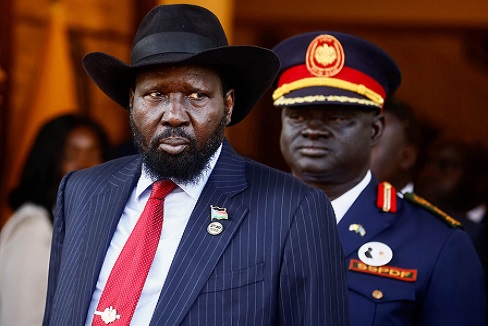
The power-sharing arrangement in South Sudan has come to an end after the South Sudanese President Salva Kiir Mayardit has dissolved the country’s Revitalised Transitional Government of National Unity and appointed a caretaker administration to steer the country towards general elections scheduled for December 22, 2026.
The dissolution took effect at midnight on Tuesday, September 22, marking the formal expiry of the transitional arrangements established under the 2018 peace agreement that ended a five-year civil war between forces loyal to Kiir and those aligned with his longtime rival, Riek Machar.
The sweeping changes removed all five vice presidents, the national cabinet, the transitional legislature and the leadership of the country’s 10 states and three administrative areas.
The move follows amendments to the National Elections Act passed by parliament on Monday and signed into law by Kiir hours later. The amended legislation allows the president to remain in office with full constitutional powers throughout the election period until an elected successor assumes office.
Kiir Remains in Charge
Among those relieved of their positions are First Vice President Riek Machar, James Wani Igga, Taban Deng Gai, Hussein Abdelbagi Akol and Rebecca Nyandeng Garang.
Machar’s removal formally ends his participation in the power-sharing presidency created under the 2018 peace deal. He has been under house arrest since March 2025 and is facing charges including treason and murder, which he denies.
The 35-member national cabinet and deputy ministers were also relieved of their duties. In their place, Kiir has appointed a smaller caretaker cabinet, with ministry undersecretaries expected to handle much of the day-to-day administration.
Africano Mande Gedima has been appointed Minister of Presidential Affairs, while Martin Elia Lomuro remains in charge of Cabinet Affairs.
Cecilia Adeng Manyok takes Foreign Affairs and International Cooperation, Ayor Akuoch Anok Defence and Veterans Affairs, Rizik Zakaria Hassan Interior, Wek Mamer Kuol Justice and Constitutional Affairs, Isaac Mamur Obete National Security, and Athian Diing Athian Finance and Planning.
Other appointments include Awow Daniel Chuang as Petroleum Minister, Labanya Margret Mathya as Trade and Industry Minister, Michael Makuei for East African Community Affairs and Stephen Par for Peacebuilding.
Parliament and States Reshaped
Kiir also dissolved the Transitional National Legislative Assembly and the Council of States, while the leadership and legislative structures of all 10 states and the three administrative areas were dismantled.
Under the amended electoral framework, the National Legislative Assembly will eventually be reduced from 650 members to 270, while state legislative assemblies will have 58 members each. Legislative councils in the administrative areas will have 20 members.
New caretaker governors have also been appointed, including Jadala Wani for Central Equatoria, Louis Lobong Lojore for Eastern Equatoria, Moses Majok Gatluak for Jonglei and James Koang Chol for Upper Nile.
Jok Charles Abyei takes charge as chief administrator of Abyei, Joseph Baboya heads Greater Pibor and Daniel Makuei Tiyar becomes chief administrator of Ruweng.
The restructuring means that the power-sharing institutions created through the 2018 agreement have effectively been replaced as the country enters the final three months before polling.
Election Rules Changed
The dissolution was made possible by changes to the electoral and constitutional framework that removed the requirement for South Sudan to complete a permanent constitution and a national population and housing census before holding elections.
Kiir signed the latest National Elections Act amendments on Monday, shortly after parliament passed them. The government says the changes are intended to remove legal obstacles and allow the National Elections Commission to proceed with preparations for the December vote.
The reforms also separate the electoral process from the permanent constitution-making process and the census, both of which had been linked to the transition under the peace arrangements.
South Sudan has not held a national election since becoming independent from Sudan in 2011. Elections have repeatedly been postponed, with the latest scheduled vote set for December 22, 2026.
Questions Over the December Vote
The transition into a caretaker administration has nevertheless raised questions about the political environment in which the elections will be conducted.
The National Elections Commission has been preparing for the vote, but voter registration had not yet begun at the time of the government’s dissolution. The opposition South Sudan Opposition Alliance has also criticised changes to the peace agreement, constitution and electoral law, arguing that the amendments were not adequately consulted among the signatories to the 2018 agreement.
The concerns come against a background of unresolved political and security issues, including delays in implementing several elements of the peace agreement.
The Council on Foreign Relations notes that key provisions of the 2018 deal, including security-sector reforms, the unification of rival forces and constitutional reforms, have remained incomplete.
The dissolution therefore represents both an administrative transition and a major change in the political framework that has governed South Sudan since the peace agreement.
For Kiir, the amended law leaves him in office with full constitutional powers during the election period. For the opposition, the removal of the vice presidents and the dissolution of the power-sharing institutions alters the political arrangement under which the country was supposed to move from conflict to elected government.
With December 22 now only three months away, the caretaker administration faces the task of maintaining government operations while the electoral authorities prepare for a vote that would mark South Sudan’s first national election since independence.







About the Author